
What Is Hindsight Bias? Why We Say “I Knew It All Along”
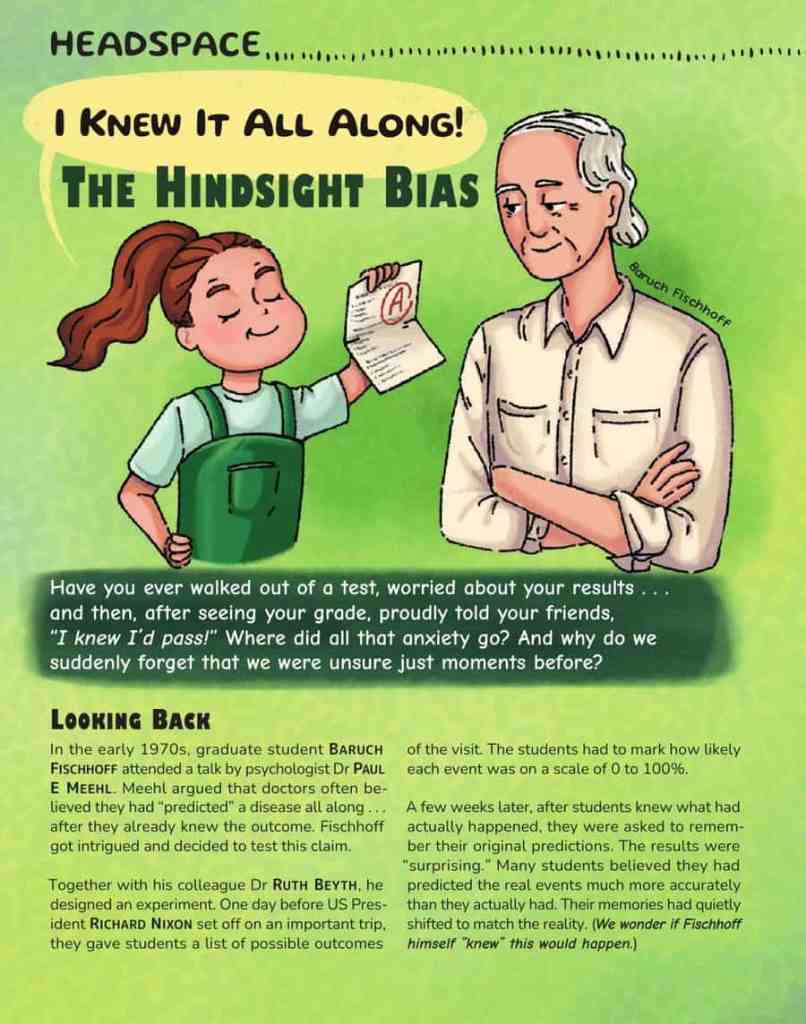
Hindsight bias is the tendency to see past events as more predictable than they really were. Once we know how something turned out, our brain quietly edits our memories, and we feel that we “knew it all along”.
Who discovered hindsight bias?
In the early 1970s, graduate student Baruch Fischhoff heard psychologist Dr Paul E. Meehl argue that doctors often believed they had predicted a disease all along, after they already knew the outcome. Together with Dr Ruth Beyth, Fischhoff tested the idea. Before US President Richard Nixon set off on an important trip, students rated how likely various outcomes were, from 0 to 100%. A few weeks later they were asked to remember their predictions. Many believed they had predicted the real events much more accurately than they had.
Key facts
- Hindsight bias makes past events seem more predictable than they were.
- Baruch Fischhoff and Ruth Beyth demonstrated it in an experiment in the early 1970s.
- A 2019 analysis found hindsight bias in people aged 3 to 95.
Why does it happen?
When you know the outcome, everything suddenly seems obvious, like spotting the villain’s clues the second time you watch a film. Our brain can edit older memories to make the story fit better. And believing we predicted something correctly feels good: it makes us more confident and less disappointed.
Where can I read the full story?
This is a short version of “I Knew It All Along! The Hindsight Bias” from OYLA Junior #12. The full article in OYLA Junior includes a Headspace Toolbox with tips for catching hindsight bias in everyday life.
Read next
Why Can’t Humans Have Naturally Blue Hair?
Human hair cannot be naturally blue because its colour comes from only two pigments: eumelanin, which gives dark…
Human Brain Facts: Why the Brain Cannot Feel Pain
The adult human brain contains about 86 billion neurons, makes up only about 2% of body mass but…

Galileo Galilei: The Rebel Who Changed Science
Galileo Galilei (born 1564 in Pisa, Italy) is often called the father of the experimental method: he tested…

The History of Sports Balls: Why Do Balls Bounce?
People have played with balls for at least 5,000 years. The first balls were made of stone, linen…
Science like this, every month
OYLA Junior is a printed science magazine for curious kids and their parents, delivered to your door across India.
Made for ages 8+
Simple language, stories, comics and activities for young readers.
12 issues a year
A new printed issue every month, delivered to your door.
Free OYLA Workbook
Hands-on activities that turn reading into doing.
Trusted by 150,000+ readers
Loved by families and used in 1,500+ schools.
Keep asking "why?" with OYLA Junior
Every issue answers the questions kids ask about the world. Start your child's science journey today.