
What Is Soil Made Of, and Why Is It in Danger?
Soil is a mixture of solid, liquid and gas: roughly 45% minerals, 25% air, 25% water and 5% organic matter. The organic part, called humus, is what makes soil fertile. Soil takes centuries to form, but erosion can strip it away quickly.
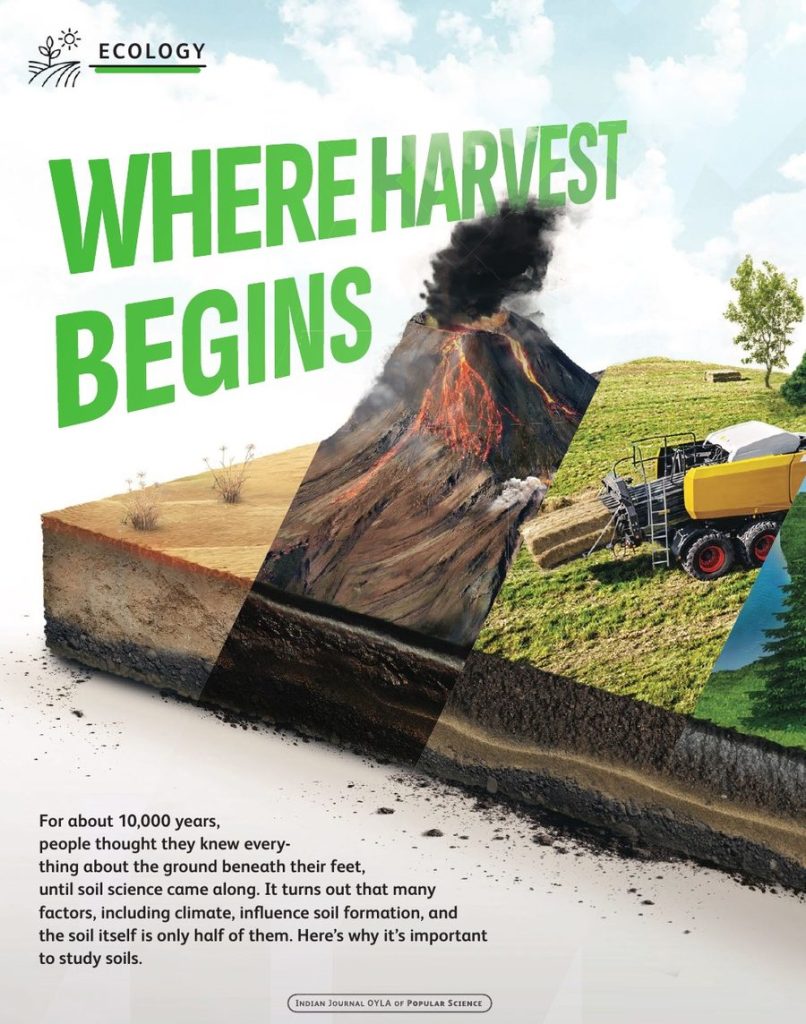
What is soil made of?
The solid part of soil consists mainly of mineral particles, from fractions of a micron to several centimetres in size, plus organic matter. The main organic component is humus, formed from partially decomposed plant and animal remains. It contains almost all the substances plants need, in forms they can easily absorb. The solid phase usually makes up only about half of the soil’s volume. The rest is pores, filled with air and water.
Key facts
- Typical soil is about 45% minerals, 25% air, 25% water and 5% organic matter.
- Vasily Dokuchaev founded soil science with Russian Chernozem in 1883.
- In volcanic clay soils, humus can be preserved for 2,000 to 5,000 years.
What is soil degradation?
Degradation is the decline of a soil’s fertility. Humus can be carried away by water or wind, which is called erosion. Soils on soft rocks such as loess are the most vulnerable. Wind erosion in the American Midwest was one of the main causes of the Dust Bowl, the catastrophic dust storms of the 1930s. Human impact is now one of the main drivers of degradation.
Where can I read the full story?
This is a short version of “Where Harvest Begins” from OYLA 12+, Vol. 8, Issue 8. The full article in OYLA 12+ includes diagrams of soil profiles and the story of how the Aral Sea bed turned into a salt desert.
Read next

Louis-Nicolas Vauquelin: The Chemist Who Discovered Chromium
Louis-Nicolas Vauquelin (born 1763) was a French chemist who discovered the element chromium in 1797 and also discovered…
Why Can’t Humans Have Naturally Blue Hair?
Human hair cannot be naturally blue because its colour comes from only two pigments: eumelanin, which gives dark…

How to Manage Pocket Money: The Envelope Method
To manage pocket money, track every bit of income and spending and give yourself a weekly limit. A…
What Is a Lingua Franca? The Search for a Universal Language
A lingua franca is a language people use to communicate when they do not share a native language.…
Science like this, every month
OYLA is a printed science magazine for curious teens and their parents, delivered to your door across India.
Made for ages 12+
In-depth articles on space, technology, biology and maths for teens.
12 issues a year
A new printed issue every month, delivered to your door.
Free OYLA Workbook
Hands-on activities that turn reading into doing.
Trusted by 150,000+ readers
Loved by families and used in 1,500+ schools.
Keep exploring with OYLA
Every issue answers the questions kids ask about the world. Start your child's science journey today.