
Louis-Nicolas Vauquelin: The Chemist Who Discovered Chromium
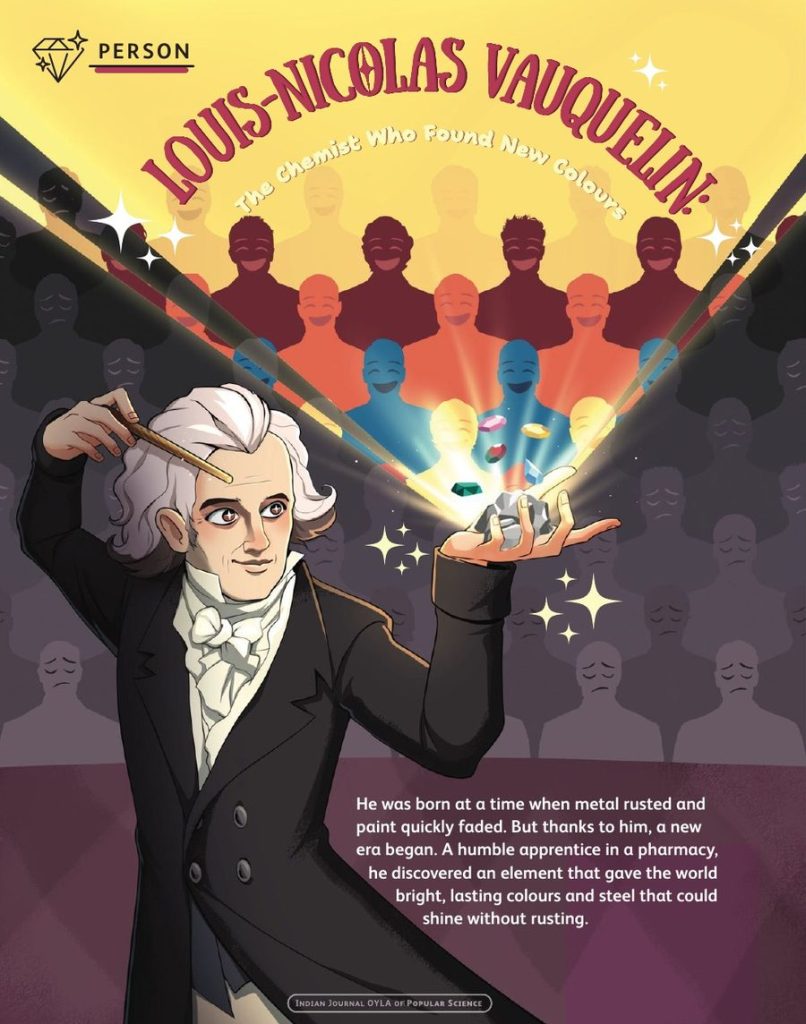
Louis-Nicolas Vauquelin (born 1763) was a French chemist who discovered the element chromium in 1797 and also discovered beryllium. His work led to bright, lasting pigments such as chrome yellow and, later, to stainless steel. He was also the first person to isolate an amino acid.
How did he discover chromium?
In 1797, Vauquelin was experimenting with Siberian red lead ore. He dissolved the mineral in acid, isolated an unknown oxide from the yellow-green solution and heated it with charcoal to extract the pure metal. He named it chromium, from the ancient Greek chrōma, meaning “colour”, because its compounds were brightly coloured. The pure metal itself is a subdued silver-grey.
Key facts
- Vauquelin was born in 1763 in northwestern France.
- He discovered chromium in 1797 while studying Siberian red lead ore.
- He also discovered beryllium, isolating it from the mineral beryl.
Why does chromium matter?
Chromium oxide gives rubies their deep red colour. In 1804, Vauquelin synthesised a lead chromate pigment later named chrome yellow, which appears most famously in Van Gogh’s Sunflowers. Chromium also made stainless steel possible: when iron is alloyed with 17 per cent or more chromium, a thin, tough film of chromium oxide forms on the surface and the steel resists rust.
Where can I read the full story?
This is a short version of “Louis-Nicolas Vauquelin” from OYLA 12+, Vol. 8, Issue 8. The full article in OYLA 12+ tells Vauquelin’s life as an illustrated story, including why the novelist Balzac mentioned him 61 times in a single novel.
Read next
Isaac Newton’s Year of Wonders: Gravity, Light and the Laws of Motion
In 1665, the Great Plague closed the University of Cambridge and sent 22-year-old Isaac Newton home to his…

Carl Friedrich Gauss: Facts About the Prince of Mathematicians
Carl Friedrich Gauss (1777–1855) was a German mathematician known as the “Prince of Mathematicians”. Born into a working-class…

Why Can’t Humans Have Naturally Blue Hair?
Human hair cannot be naturally blue because its colour comes from only two pigments: eumelanin, which gives dark…

How to Manage Pocket Money: The Envelope Method
To manage pocket money, track every bit of income and spending and give yourself a weekly limit. A…
Science like this, every month
OYLA is a printed science magazine for curious teens and their parents, delivered to your door across India.
Made for ages 12+
In-depth articles on space, technology, biology and maths for teens.
12 issues a year
A new printed issue every month, delivered to your door.
Free OYLA Workbook
Hands-on activities that turn reading into doing.
Trusted by 150,000+ readers
Loved by families and used in 1,500+ schools.
Keep exploring with OYLA
Every issue answers the questions kids ask about the world. Start your child's science journey today.