
What Are Photonic Crystals? How Butterflies and Opals Control Light
A photonic crystal is a material with a repeating pattern of regions that bend light differently, such as alternating layers or tiny holes. Because of this pattern, it lets some colours of light pass through and reflects others, a bit like a traffic controller for light.
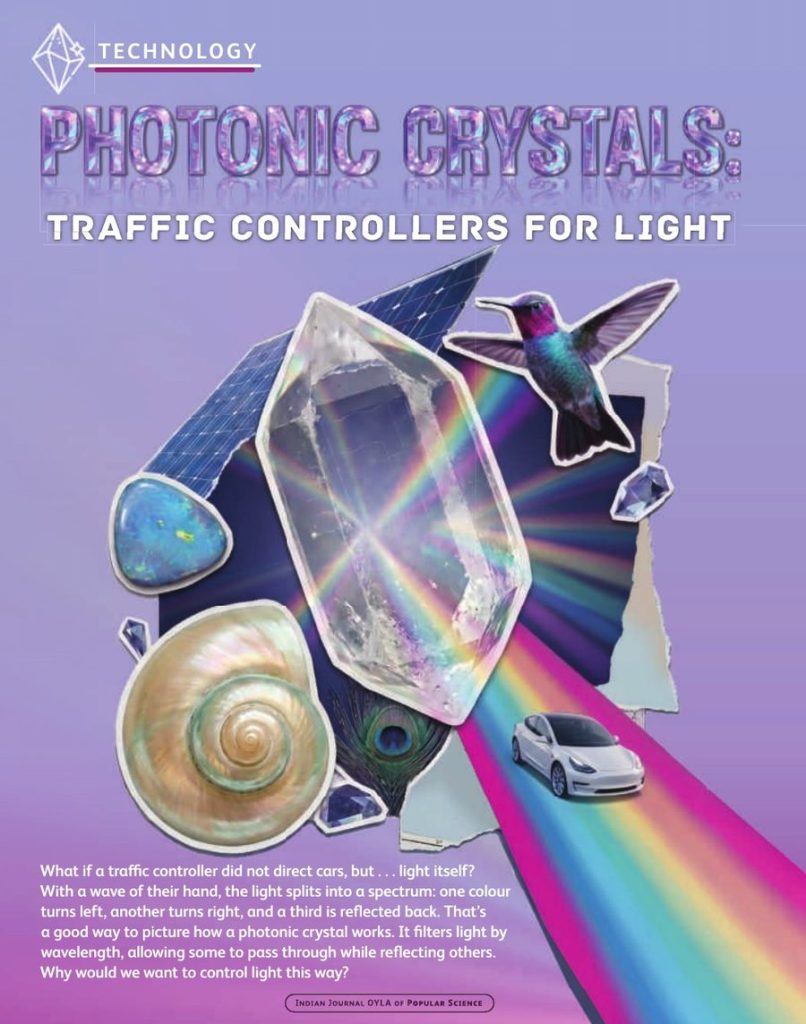
How do photonic crystals work?
When light reaches the boundary between two materials with different refractive indices, part of it is reflected. A photonic crystal has many such boundaries. If the reflected waves are in phase, they reinforce one another and the reflection can approach 100%; if they are out of phase, they cancel out and more light passes through. The range of colours that cannot pass through is called the photonic band gap.
Key facts
- Photonic crystals were first proposed in 1987.
- Structural colours often change with the viewing angle and lighting.
- Many photonic-crystal devices need precision at the nanometre scale, so they are still costly to make.
Where are photonic crystals found in nature?
Nature used them long before people did. Mother-of-pearl in mollusc shells is made of alternating mineral and organic layers. The wing scales of the green swallowtail butterfly contain layers of chitin and air, so its colour flashes as the viewing angle changes. Opal gets its iridescence from a regular arrangement of silica spheres. Peacock and hummingbird feathers use similar structures to produce colour without pigments. Unlike pigments, which absorb some wavelengths, these structures create colour by reflecting light.
What are photonic crystals used for?
The idea was proposed in 1987 by physicist Eli Yablonovitch, who wanted to make semiconductor lasers more efficient. Today photonic crystals are used in high-precision lasers, sensors and telecommunications parts. They can help solar cells trap more sunlight, sit at the heart of ultrasensitive virus detectors and steer the laser beams of compact chip-based lidar in self-driving cars.
Where can I read the full story?
This is a short version of “Bending the Rules” from OYLA 12+, Vol. 12, Issue 10 (October 2026). The full article in OYLA 12+ calculates the layer thicknesses for a blue-reflecting crystal and explains virus-detecting sensors step by step.
Read next

Carl Friedrich Gauss: Facts About the Prince of Mathematicians
Carl Friedrich Gauss (1777–1855) was a German mathematician known as the “Prince of Mathematicians”. Born into a working-class…

Cognitive Biases: Thinking Traps That Fool Even Scientists
Cognitive biases are mental shortcuts that help the brain decide quickly but can lead it astray. We notice…
Who Was Diogenes? The Philosopher Who Lived in a Jar
Diogenes (about 404–323 BCE) was an ancient Greek philosopher of the Cynic school. He sought freedom by giving…
Atlantis, El Dorado and Lemuria: The Truth About Legendary Lost Lands
There is no evidence that Atlantis, El Dorado or other legendary lost lands ever existed. But none of…
Science like this, every month
OYLA is a printed science magazine for curious teens and their parents, delivered to your door across India.
Made for ages 12+
In-depth articles on space, technology, biology and maths for teens.
12 issues a year
A new printed issue every month, delivered to your door.
Free OYLA Workbook
Hands-on activities that turn reading into doing.
Trusted by 150,000+ readers
Loved by families and used in 1,500+ schools.
Keep exploring with OYLA
Every issue answers the questions kids ask about the world. Start your child's science journey today.