
What Is Noise Pollution and How Does It Affect People and Animals?
Noise pollution is excessive or unwanted sound that drowns out the natural sounds of an environment. Traffic, aircraft, construction and loud music all add to it. Long-term exposure can raise stress hormones, disturb sleep and contribute to high blood pressure, and for many animals it can even threaten survival.
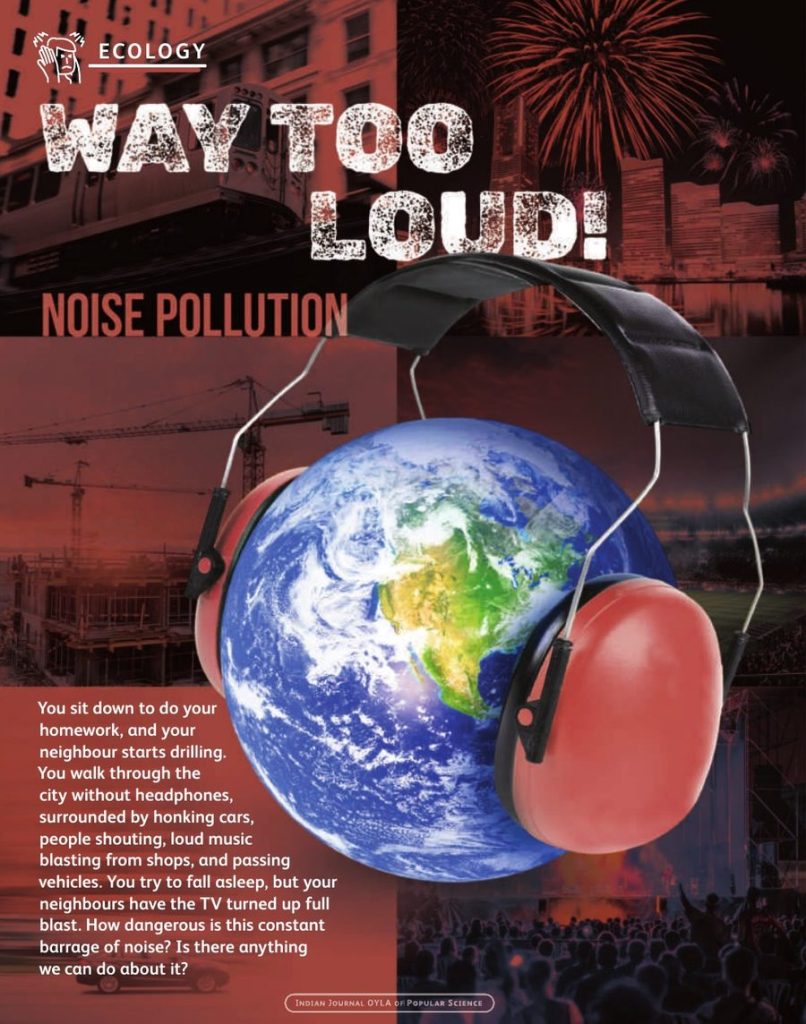
How loud is too loud?
Noise is measured in decibels (dB). The World Health Organization recommends keeping noise outside bedrooms at night below 40 dB, about as loud as the hum of a refrigerator, and below 30 dB inside the bedroom for good sleep, roughly the sound of a ticking wall clock. A sudden loud noise triggers adrenaline, but repeated stress responses keep the hormone cortisol elevated, which over time can affect blood pressure, memory and sleep.
Key facts
- In India, quiet hours generally run from 10:00 pm to 6:00 am.
- Researchers began calling the problem “noise pollution” by the late 1960s.
- Bees may collect less nectar in noisy environments.
How does noise affect animals?
Many animals depend on hearing to find food, avoid danger and find mates. Some birds, such as sparrows and tits, often sing at higher pitches in noisy places, which can cost extra energy. Whales use a natural sound channel in the ocean, usually around 1 km deep, to call across hundreds or even thousands of kilometres, and ship noise works like static on that line. Noise can also “blind” animals that use echolocation, such as bats and dolphins.
Can we make the world quieter?
Yes. Noise barriers and trees along roads absorb sound, porous asphalt reduces tyre noise, and engineers design quieter ship propellers. When large ships slowed down in Puget Sound, USA, during the 2023–2024 orca season, underwater noise reaching the whales fell by about 45%. At home, rugs, bookcases and a lower speaker volume all help, and many cities limit construction and loud music at night.
Where can I read the full story?
This is a short version of “Quiet, Please” from OYLA 12+, Vol. 12, Issue 10 (October 2026). The full article in OYLA 12+ includes a decibel chart and five ways you can help reduce noise pollution.
Read next

Types of Mountains and the World’s Most Amazing Peaks
Mountains cover about a quarter of Earth's land surface, and no two are exactly alike. Besides the ranges…
How Do Rainbows Form? Why Every Rainbow Is Really a Circle
A rainbow forms when sunlight shines into raindrops. Sunlight looks white, but it is really all colours mixed…

Carl Friedrich Gauss: Facts About the Prince of Mathematicians
Carl Friedrich Gauss (1777–1855) was a German mathematician known as the “Prince of Mathematicians”. Born into a working-class…

Cognitive Biases: Thinking Traps That Fool Even Scientists
Cognitive biases are mental shortcuts that help the brain decide quickly but can lead it astray. We notice…
Science like this, every month
OYLA is a printed science magazine for curious teens and their parents, delivered to your door across India.
Made for ages 12+
In-depth articles on space, technology, biology and maths for teens.
12 issues a year
A new printed issue every month, delivered to your door.
Free OYLA Workbook
Hands-on activities that turn reading into doing.
Trusted by 150,000+ readers
Loved by families and used in 1,500+ schools.
Keep exploring with OYLA
Every issue answers the questions kids ask about the world. Start your child's science journey today.