
How Do Rainbows Form? Why Every Rainbow Is Really a Circle
A rainbow forms when sunlight shines into raindrops. Sunlight looks white, but it is really all colours mixed together. Inside each drop, the light bends, bounces off the back of the drop and bends again on the way out, and each colour leaves at its own angle, spreading the light into a band of colours.

Why are the colours always in the same order?
You see light only from raindrops at certain angles around the antisolar point, the spot in the sky directly opposite the Sun, in the direction of your shadow. Red light reaches your eyes from drops about 42° above that point and violet from drops about 40° above it, with the other colours in between. That is why every rainbow has the same order of colours. It also means the rainbow you see is yours alone: the person next to you sees one made by a different set of raindrops.
Key facts
- Hawaii is called the rainbow capital because it gets more rainbows a year than anywhere else.
- In Norse mythology, the rainbow was Bifrost, a glowing bridge to Asgard, the home of the gods.
- Only clear, unpolluted water droplets can form a bright rainbow.
Why is a rainbow curved?
Because a rainbow is really a full circle around the antisolar point. The ground hides the bottom half, so we usually see only an arc. From an aeroplane or a very tall mountain, you can sometimes see the whole ring. The lower the Sun, the higher the rainbow, which is why rainbows love early mornings and late afternoons.
What is a double rainbow?
Sometimes a fainter second rainbow, the secondary bow, appears above the main one. It forms when sunlight bounces twice inside each raindrop, which makes it dimmer and flips the colours: violet is on the outside and red on the inside. The darker sky between the two bows is called Alexander’s dark band.
Where can I read the full story?
This is a short version of “Living Under the Rainbow” from OYLA Junior #15 (October 2026). The full article in OYLA Junior also shows how to make your own mini rainbow with a garden hose.
Read next
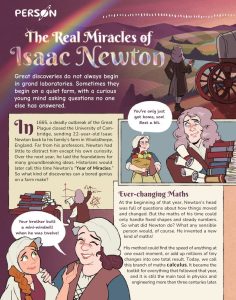
Isaac Newton’s Year of Wonders: Gravity, Light and the Laws of Motion
In 1665, the Great Plague closed the University of Cambridge and sent 22-year-old Isaac Newton home to his…

What Do Colours Mean Around the World?
The same colour can mean very different things in different cultures. In European countries, brides traditionally wear white,…

Types of Mountains and the World’s Most Amazing Peaks
Mountains cover about a quarter of Earth's land surface, and no two are exactly alike. Besides the ranges…
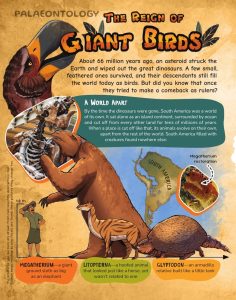
What Were Terror Birds? The Giant Birds That Ruled South America
Terror birds, or Phorusrhacids, were flightless predatory birds that ruled South America for tens of millions of years…
Science like this, every month
OYLA Junior is a printed science magazine for curious kids and their parents, delivered to your door across India.
Made for ages 8+
Simple language, stories, comics and activities for young readers.
12 issues a year
A new printed issue every month, delivered to your door.
Free OYLA Workbook
Hands-on activities that turn reading into doing.
Trusted by 150,000+ readers
Loved by families and used in 1,500+ schools.
Keep asking "why?" with OYLA Junior
Every issue answers the questions kids ask about the world. Start your child's science journey today.