
How Did People Send Messages Before Phones?
Before phones, people sent messages with smoke signals, beacon fires and talking drums, then with couriers, horses, pigeons and ships. Public postal services appeared in the early 1500s, and the electric telegraph of 1837 finally made messages almost instant.
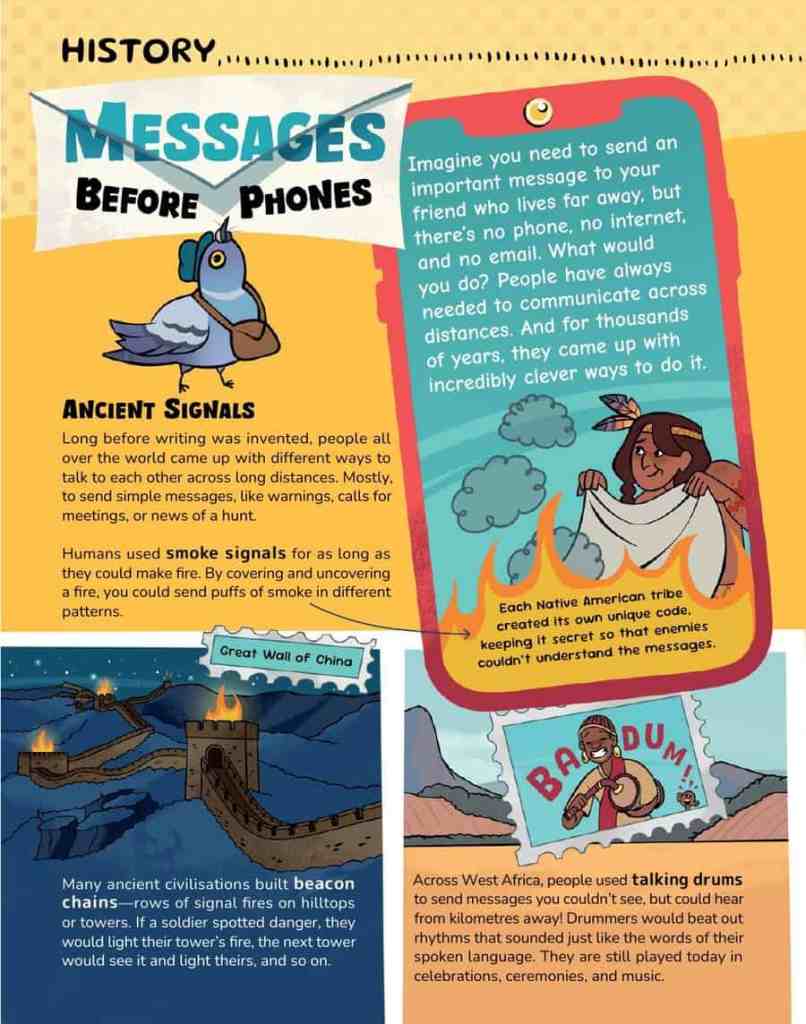
How did people send messages before writing?
They used signals that could be seen or heard from far away. By covering and uncovering a fire, people sent puffs of smoke in different patterns. Many ancient civilisations built beacon chains, rows of signal fires on hilltops or towers: one tower lit its fire, the next saw it and lit theirs, and so on. Across West Africa, drummers beat out rhythms on talking drums that sounded like the words of their spoken language and could be heard from kilometres away.
Key facts
- A horse at full gallop could reach 65 km/h, five times faster than a person on foot.
- Carrier pigeons were used from around 1300 BCE until the 20th century.
- The first public postal service began in the Holy Roman Empire in the early 1500s.
What made messages instant?
Electricity. In 1837, Samuel Morse and Alfred Vail built an early electric telegraph that sent short and long pulses, dots and dashes, down a wire. This became known as Morse code. By 1866 a cable lay across the bottom of the Atlantic Ocean, and a message from London could reach New York in minutes. In 1876, Alexander Graham Bell was granted a patent for the telephone.
Where can I read the full story?
This is a short version of “Messages Before Phones” from OYLA Junior #11. The full article in OYLA Junior follows the whole journey in pictures, from smoke signals on the Great Wall of China to the first telephone.
Read next

What Do Colours Mean Around the World?
The same colour can mean very different things in different cultures. In European countries, brides traditionally wear white,…

Who Was Diogenes? The Philosopher Who Lived in a Jar
Diogenes (about 404–323 BCE) was an ancient Greek philosopher of the Cynic school. He sought freedom by giving…
Atlantis, El Dorado and Lemuria: The Truth About Legendary Lost Lands
There is no evidence that Atlantis, El Dorado or other legendary lost lands ever existed. But none of…

Famous Cemeteries of the World: From the Paris Catacombs to Hanging Coffins
Cemeteries are more than places of remembrance: they show how different cultures understand life and death. Large historic…
Science like this, every month
OYLA Junior is a printed science magazine for curious kids and their parents, delivered to your door across India.
Made for ages 8+
Simple language, stories, comics and activities for young readers.
12 issues a year
A new printed issue every month, delivered to your door.
Free OYLA Workbook
Hands-on activities that turn reading into doing.
Trusted by 150,000+ readers
Loved by families and used in 1,500+ schools.
Keep asking "why?" with OYLA Junior
Every issue answers the questions kids ask about the world. Start your child's science journey today.