
What Is Gravity? Why Things Fall Down
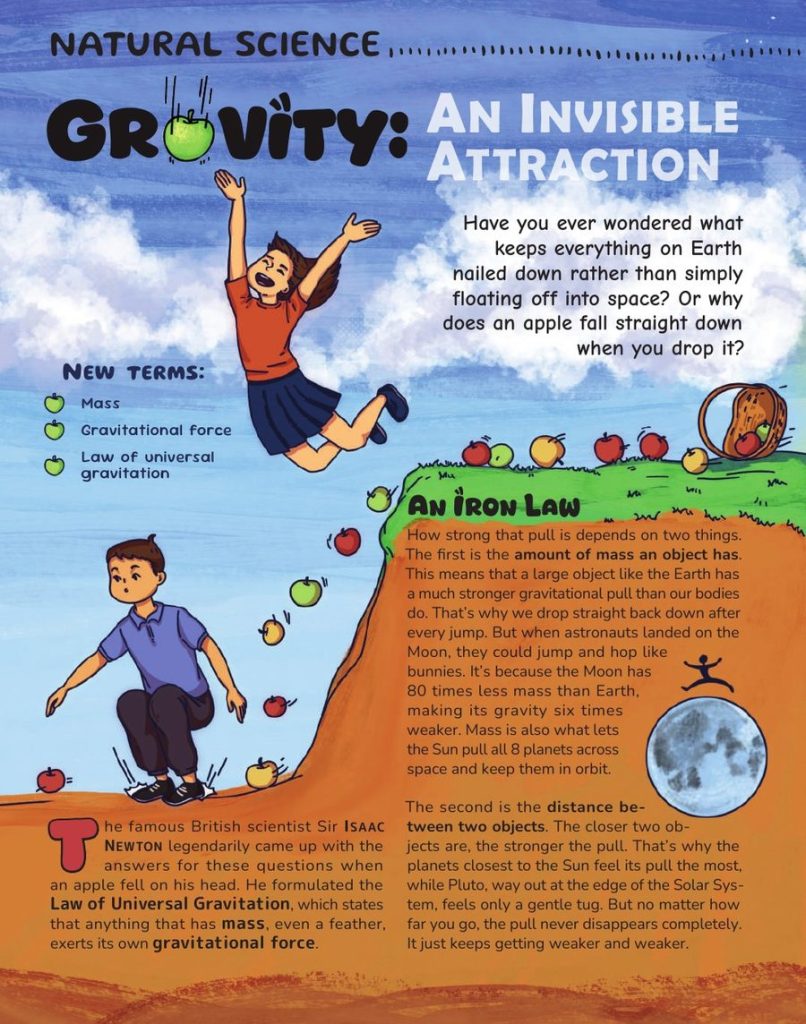
Gravity is the invisible pull that every object with mass has on every other object. The Earth is so massive that its pull keeps us and the air around the planet in place, and makes a dropped apple fall straight down. The more mass an object has, and the closer you are to it, the stronger its pull.
How Does Dishwashing Liquid Remove Grease?

Dishwashing liquid removes grease because it contains surfactants: molecules with a water-loving head and a grease-loving tail. The tails sink into the grease while the heads face the water, so scrubbing breaks the grease into tiny coated droplets that can be rinsed away.
How Does Water Evaporate? Why Wet Clothes Dry Even in Freezing Weather

Water evaporates whenever some of its molecules gain enough energy to escape from the surface into the air as invisible water vapour. It does not have to boil: that is why puddles disappear after rain and wet clothes dry at room temperature. Warmth, dry air and wind all speed evaporation up.
What Is Corrosion? Why Metals Rust and How to Stop It

Corrosion is the process by which metals and their alloys are destroyed by chemical reactions with their environment, such as air, water and acids. Rust on iron is the best-known example. Corrosion costs the world approximately $2.5 trillion every year.
How Do Particle Accelerators Work? From Light Bulb to Collider

A particle accelerator uses electric fields to speed up charged particles and magnetic fields to steer them, then smashes them into a target or into each other. The higher the energy, the deeper physicists can look into matter. The most powerful one, the Large Hadron Collider, discovered the Higgs boson in 2012.