
How to Make a Regular Pentagon from a Paper Knot
Cut a strip of paper of constant width, tie a simple overhand knot, tighten it and carefully flatten it. Trim off the ends and you are left with a pentagon. Surprisingly, it is a regular pentagon: all five sides and all five angles are equal, and simple geometry can prove it.
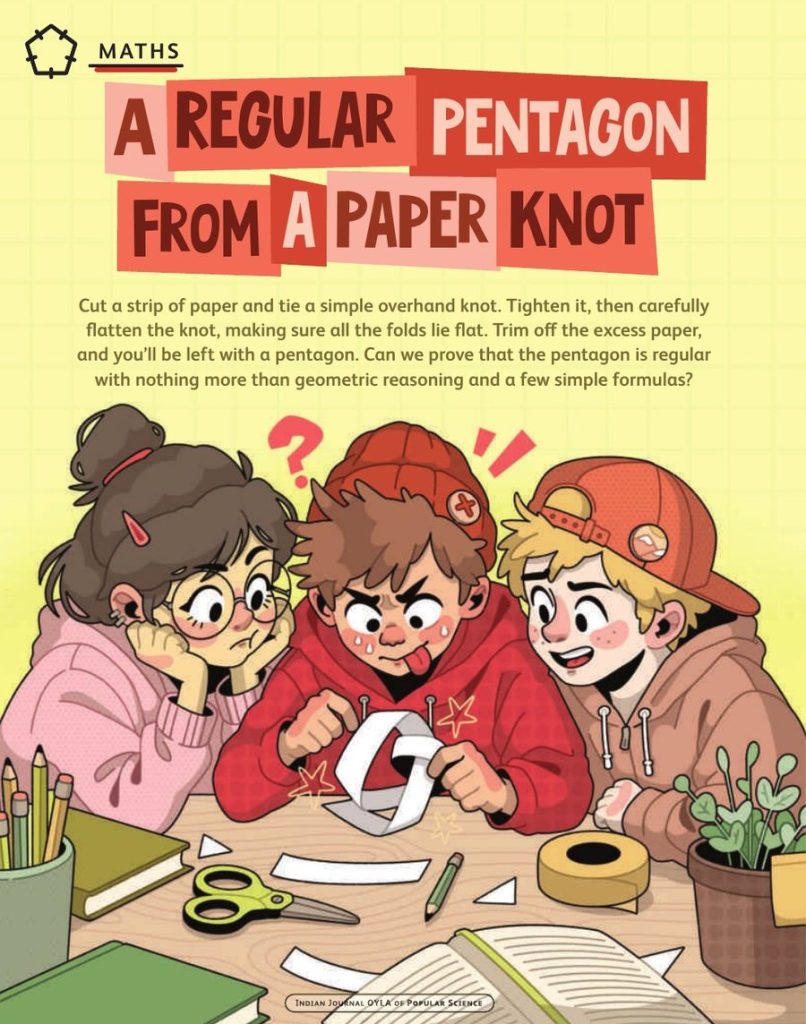
Why does a paper knot make a regular pentagon?
The secret is the width of the strip. Wherever two strips of equal width cross, they form a rhombus, a shape with four equal sides, because every altitude of that shape equals the width of the paper. A flattened knot contains several such crossings, and comparing them one by one shows that all five sides of the pentagon are equal. A second step, using the trapezoids hidden inside the pentagon, shows that its angles are equal too.
Key facts
- The strip must have a constant width, with parallel top and bottom edges.
- Two crossing strips of equal width always form a rhombus.
Where can I read the full story?
This is a short version of “A Knotty Problem” from OYLA 12+, Vol. 12, Issue 10 (October 2026). The full article in OYLA 12+ walks through both proofs step by step, with diagrams.
Read next

Carl Friedrich Gauss: Facts About the Prince of Mathematicians
Carl Friedrich Gauss (1777–1855) was a German mathematician known as the “Prince of Mathematicians”. Born into a working-class…

Cognitive Biases: Thinking Traps That Fool Even Scientists
Cognitive biases are mental shortcuts that help the brain decide quickly but can lead it astray. We notice…

Who Was Diogenes? The Philosopher Who Lived in a Jar
Diogenes (about 404–323 BCE) was an ancient Greek philosopher of the Cynic school. He sought freedom by giving…
Atlantis, El Dorado and Lemuria: The Truth About Legendary Lost Lands
There is no evidence that Atlantis, El Dorado or other legendary lost lands ever existed. But none of…
Science like this, every month
OYLA is a printed science magazine for curious teens and their parents, delivered to your door across India.
Made for ages 12+
In-depth articles on space, technology, biology and maths for teens.
12 issues a year
A new printed issue every month, delivered to your door.
Free OYLA Workbook
Hands-on activities that turn reading into doing.
Trusted by 150,000+ readers
Loved by families and used in 1,500+ schools.
Keep exploring with OYLA
Every issue answers the questions kids ask about the world. Start your child's science journey today.