THE MOON IS TO BLAME
If you go to the shore in the early morning and stay there all day, you can observe an interesting phenomenon. Leave your towel in the sand about 30 feet from the water. In a few hours, you’ll find that the surf is splashing nearby or has already swept it off into the deep. If you keep watching, you’ll notice that after a certain period of time, the water begins to recede and the towel falls back farther than it was even at the beginning of your observation. This is due to gradual changes in the water level, called <strong>high tide</strong> and <strong>low tide</strong>. The more gradual the shore’s slope, the more visible these changes are.
Many of you have probably heard that the tide is connected to the Moon. It’s true: our planet’s satellite unevenly affects the World Ocean with the strength of its gravitational pull — the closer to the Moon, the stronger the effect. Let’s recall the formula for the force of gravity. It is inversely proportional to the square of the distance between the objects in question. When dealing with the distance to the Moon, such distances as the radius and diameter of the Earth are important. Therefore, due to the differences in force, water is “distorted” into bulges.
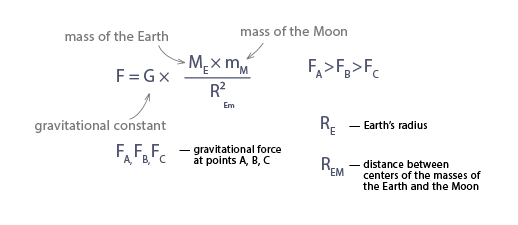
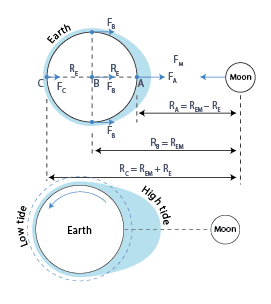
Let’s imagine that the Earth rotates inside of these bulges of water. From one point on the planet, an observer will experience the sequential phase of high tide and low tide within one rotation (24 hours). It seems logical enough, right?
The biggest waves | Explanation
In reality, though, we observe that, in a 24-hour period, the water level changes four times. Twice a day, the beach will grow very narrow — corresponding to the high water level, called high tide. Twice a day, it will reach its maximum width — due to the water level reaching its minimum, called low tide.

Our reasoning thus far has explained the occurrence of only one low tide and one high tide. So, where do the other two come from?
IT’S ALL MORE COMPLICATED THAN YOU THINK
The majority of people think that the Moon orbits around the Earth, but that’s not exactly the case. In actuality, the Earth and the Moon revolve around the center of mass in the Earth-Moon system. Because our planet is twice as heavy as the Moon, the center of mass is located inside the Earth, at a point situated at a distance from the Earth’s center that is equal to about 2/3 of the planet’s radius. This is why it seems to us that the Moon revolves around our planet.
As it works out, the Earth also completes a small revolution around this center of mass. This is not observable to us, but the water that covers our planet’s surface, due to inertia, tries to “run away” from the center of this revolution. Centrifugal force is identical at every point on Earth.

At point A, the closest to the Moon, it slightly weakens the force of gravity, while at point C, on the opposite side. The force grows stronger and pulls the World Ocean into a bulge.
FORCES AT PLAY IN HIGH
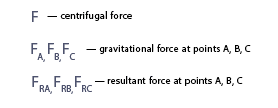

As a result of the two forces involved, an effect appears, forming the stretched out, oval-like shape on which the observer rotates and, therefore, sees two high tides and low tides in a 24-hour period.
The biggest waves | More facts:
There’s still one other phenomenon — the time between high tides changes slightly. Why is this so? We have to take into account the fact that during the time in which the Earth completes one rotation, the Moon changes place. One full lunar cycle is composed of 28 days, meaning that, in one 24-hour period, the Moon traverses 1/28 of its orbit. The maximum water level, in turn, depends on the Moon, so in order to catch a full high tide, an observer on Earth has to wait another 50 minutes or so (in one day, there are 24×60=1440 minutes, 1/28 of which is approximately equal to 50 minutes)
HIGH TIDE DEPENDS ON THE MOON, WHICH ALSO CHANGES POSITION
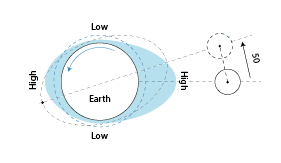
That is, one complete lunar cycle of high tides and low tides for the observer finishes in 24 hours plus 50 minutes. In order to determine the time between high tide and low tide, this period should be divided by four. As a result, the time between a full low tide and a full high tide equals 6 hours and 12 minutes
THE SUN’S INFLUENCE
HIGH TIDES AND LOW TIDES IN RELATION TO THE POSITIONS OF THE SUN AND THE MOON
The Moon is not the only object that interacts with the Earth’s water. The relationship to the Sun follows the same system: gravity pulls the water bulge in the direction of the giant star, and inertia pulls it the other way.
Relative to the total distance between the Earth to the Sun, the difference in gravity between points in different parts of the planet is small, so the Sun’s resulting «oval» is smaller than that of the Moon. The final picture is the sum of two interactions, and while a full high tide is always pulled in the direction of the Moon, its absolute value depends on the mutual positions of the Moon and the Sun.
This how we can explain it: it’s all connected to the phases of the Moon. When it is located along one line with the Sun, which occurs during the new moon and full moon, their oval shapes scrunch up, intensifying the difference between high tide and low tide. On the contrary, when the Moon and the Sun are located along perpendicular lines, when a half-moon is visible, the bulges compensate each other, and the water level changes insignificantly over the course of a 24-hour period.

If you watch the water level line during high tides and low tides over the course of a month, you’ll notice that it fluctuates heavily at times and, at others, insignificantly.
IS HIGH TIDE THE SAME EVERYWHERE?
As for the absolute value of high tides and low tides, it all depends upon the point at which we observe them. You can imagine a tidal bulge as a giant wave that encompasses the Earth and runs along its surface. Where this wave runs into small islands along its path, it passes along with very minimal changes, as if through a sieve. It’s another story entirely when it happens upon the wide shore of a continent. The land slows down the water, needing it to find another way around. Thus, the water flows faster than it ebbs, and, as a result, the absolute value of high tide is higher.
At several points on our planet, due to the peculiarities of the coastline, anomalies in the height of high tide and low tide occur. The record-holder in this area is the Bay of Fundy, in Canada. There, the highest-ever recorded maximum amplitude of water level difference between high tide and low tide reached an incredible value: over 50 ft!
It’s helpful to know that a high tide pulled in the direction of the Moon is always a bit bigger than one sent in the other direction. By understanding the phases of the Moon, you can predict how quickly water will ebb and flow. Since the time between high tide and low tide is always the same — 6 hours and 12 minutes. The absolute value is higher during the full moon and new moon phases, the water level changes most quickly on these days of the month.
The biggest waves | Conclusion
The phenomenon of the biggest waves on the planet is a testament to the extraordinary power and complexity of our oceans. From the gentle swells we see on our favorite beaches to the towering giants that challenge even the bravest surfers, waves are in a constant state of motion, driven by a multitude of natural forces. We think it’s really interesting and exciting topic.
Post on topic: The biggest waves.
We invite you to read our other topics in Education category.
Follow us on Instagram
High tides and low tides play an integral role in nature because they affect the most important part of our planet, the oceans. Many scientists associate the appearance of life itself with the occurrence of high tides and low tides. It’s possible that coastal zones were once natural chemistry labs, where diverse chemical components mixed and interacted with one another to create endless combinations. One of the most successful creations could have sparked life.