Post on topic: Why Is It Dark at Night?
A Simple but Incorrect Answer
This question has a “grown-up” name — the photometric paradox. More than one generation of scientists has wracked their brains trying to find its answer. We’ll start by explaining in simple terms: the stars are extremely far away, so their light weakens as it travels towards us. Illumination (the amount of luminous flux per unit area), referred to in astronomy as apparent stellar magnitude, decreases inversely to the distance squared. Therefore, if a star like our Sun, a yellow dwarf of spectral class G2, is pushed back by 1000 astronomical units, it will illuminate the Earth a million times less intensely. By cosmic standards, this distance is nothing (less than 140 light-hours), however, the decrease in brightness is quite noticeable.
Inverse Square Law
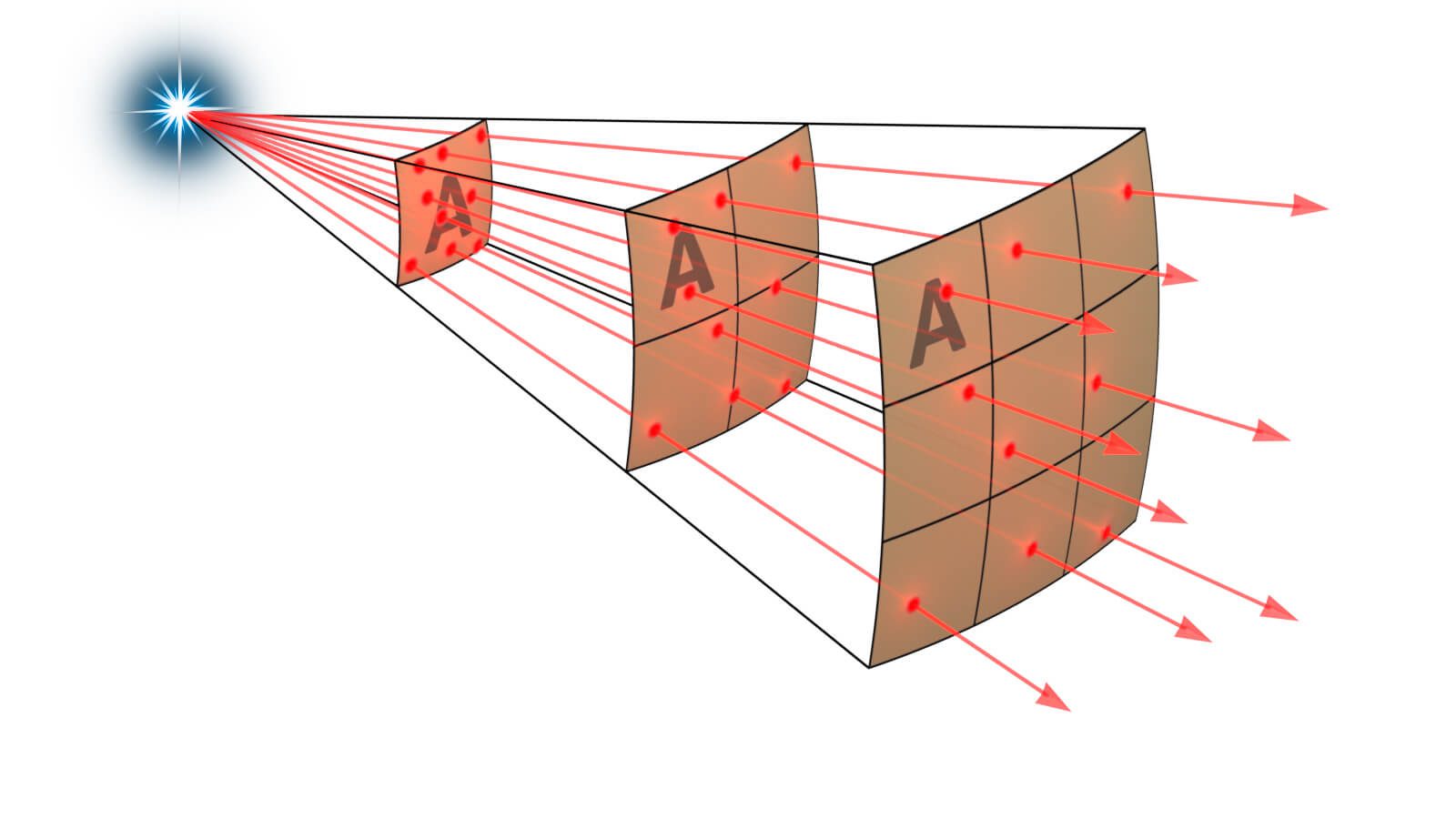
Red lines indicate the radiation flux from the source. The total number of lines remains unchanged with increasing distance.
Note the density of the lines (quantity per unit area): the closer to the source, the higher it is. In other words, the density of flow lines is inversely proportional to the square of the distance from the source. This is due to the fact that the surface area of the sphere increases in proportion to the square of the radius.
Dark Skies and Distant Stars
It is not surprising that our “neighbor” Proxima Centauri (Proxima is Latin for “closest”), which is just 4.2 light-years away from Earth (270 thousand astronomical units), was discovered only in 1915. Its luminosity is so weak that Proxima cannot be seen with the naked eye even under ideal conditions. But is that all there is to it?
Not quite. The farther from Earth, the more stars there are — the quantity of stars also grows in proportion to the square of the distance. It turns out that the weaker brightness of the stars is compensated by an increase in their number, so the total illumination should be more or less constant.
Dark Sky Paradox
The famous English astronomer Edmund Halley was the first to arrive at this conclusion. On March 9, 1721, he presented the report “Of the Infinity of the Sphere of Fix’d Stars” at a meeting of the Royal Society, in which he presented the universe as an “onion” of infinite layers. As you move through the layers away from Earth, the total number of stars surges, compensating for the decrease in illumination. However, for very distant stars, no quantity of stars can compensate for the weakness of light, which explains the blackness of the night sky. Halley even debated the question with Johannes Kepler himself, who had long struggled to answer this “child’s” question and, in despair, proposed a crazy hypothesis — the universe is not infinite; we live inside of a huge shell and see only the light from a small number of “captive” stars encapsulated in it.
                                                <img width="730" height="730" src="https://oyla.us/wp-content/uploads/2023/08/image-2-7.png" alt="A black and white drawing of a man with curly hair, dark at night." srcset="https://i0.wp.com/oyla.us/wp-content/uploads/2023/08/image-2-7.png?w=730&ssl=1 730w, https://i0.wp.com/oyla.us/wp-content/uploads/2023/08/image-2-7.png?resize=300%2C300&ssl=1 300w, https://i0.wp.com/oyla.us/wp-content/uploads/2023/08/image-2-7.png?resize=150%2C150&ssl=1 150w, https://i0.wp.com/oyla.us/wp-content/uploads/2023/08/image-2-7.png?resize=400%2C400&ssl=1 400w, https://i0.wp.com/oyla.us/wp-content/uploads/2023/08/image-2-7.png?resize=200%2C200&ssl=1 200w" sizes="(max-width: 730px) 100vw, 730px" />
    <p>Edmund Halley
(1656−1736)
According to Edmund Halley’s “onion” model, the number of stars in the universe is infinite. In this case, the decrease in the brightness of stars should be balanced by an increase in their number in the regions of space that are farther from the observer. As a result, the night sky should not be black but one shiny surface.
The Emergence of the Dark Sky Paradox
What If We Do the Calculation?
The ideas of Halley were not mathematically formulated and were rather speculative in nature. Moreover, as it later turned out, the Englishman was fundamentally mistaken, having disregarded the contribution of distant stars to the total luminous flux received on Earth. At the end of 1744, the Swiss astronomer and physicist Jean‐Philippe Loys de Chéseaux performed a mathematical analysis of Halley’s hypothesis and came to some shocking conclusions. If the star space is infinite, then any part of the celestial sphere should shine like the Sun, since the stars would fill the entire sky with their disks! The total luminosity of the visible hemisphere, according to Chéseaux, should amount to 92,000 times greater than that of the Sun.
Dark Sky Dilemma: Exploring Chéseaux and Olbers’ Theories on Night’s Darkness
However, what we witness is a completely different picture! In search of an answer, the scientist reasoned: “The huge discrepancy between this conclusion and the empirical data shows that either the sphere of fixed stars is finite, or the illumination diminishes not according to the inverse square law but faster.” Chéseaux tended to think there was one more factor — the absorption of light by some rarefied medium filling the interstellar space, for example, a gas-dust mixture. Heinrich Wilhelm Matthäus Olbers held the same opinion.
Olbers is often referred to as having been an amateur astronomer, but any professional scientist would envy his contributions to science. The German physician-turned-astronomer discovered two of the largest minor planets — Pallas and Vesta — as well as five comets. He also came up with a new method for determining cometary orbits and thoroughly studied the problem formulated by Halley. Olbers’ article “On the Transparency of Space,” published in 1823, is perhaps the first scientifically based statement on the problem, substantiated by mathematical calculations and up-to-date (for the time) astronomical data.

Wilhelm Olbers
(1758−1840)
The astronomers Chéseaux and Olbers believed that the night sky was not fully lit because the illumination of distant stars was absorbed by cosmic dust. This assumption turned out to be erroneous: by virtue of the law of conservation of energy, dust heats up and also emits light.
A Wrong Solution to the Paradox

Dust Is to Blame
The fundamentality of the case made an impression on the scientist’s contemporaries, and the “child’s” question received a scientific designation— “Olbers’ paradox” (Chéseaux is sometimes credited as a contributor). However, it still wasn’t enough to find the correct answer. In 1848, the English astronomer John Herschel, son of the famous royal astronomer William Herschel, analyzed the Chéseaux-Olbers thesis and came to an amazing conclusion: the interstellar medium, which absorbs light, warms over time and becomes a new source of radiation!
Thus, in an infinite universe, with uniform distribution of stars, dust can shield the light only for a relatively short time until it begins to radiate on its own. There is no other scenario, as the law of conservation of energy must be valid, especially when applied to thermodynamic systems.
Herschel’s Hypothesis on the Enigmatic Darkness of the Cosmos
According to Herschel, the solution to the question of the dark sky lies in the honeycomb structure of the cosmos: if we see nothing, there is actually nothing. The Milky Way is one of the few lucky places Earthlings could have found themselves: it is the far side of the universe, occupying a relatively small area, so most of our space is absolutely empty. From a geometrical point of view, fractal structures have a similar organization — self-repeating systems in which an arbitrary number of lines of sight will not fall on star disks. Herschel’s explanation relieved the problem to an extent and was supported by authoritative astronomers: the English Richard A. Proctor, Swedish Carl Charlier, and the Irish Edmund Edward Fournier d’Albe.
New methods of astronomical research were needed to confirm (or refute) Herschel’s hypothesis, like observations in other radiation spectra, the construction of large telescopes, and the introduction of photography, all of which required time and money — sometimes considerable amounts of both. The solution to the photometric paradox was briefly set aside.
<h2>The Universal Detective
It’s hard to believe that a fantastically far-sighted solution had already been published in… 1848! We’re talking about the non-fiction prose poem Eureka, written by American writer and poet Edgar Allan Poe, who published 500 copies of it at his own expense. The originator of several literary genres, who had a great influence on American (and global) literature, was so interested in astronomy and cosmology that he devoted one of his most essential works to the problems of the universe. Expressing ideas that were seditious from most scientists’ point of view, Poe did not expect them to be understood. However, he was convinced that someday, many years later, they would be appreciated.
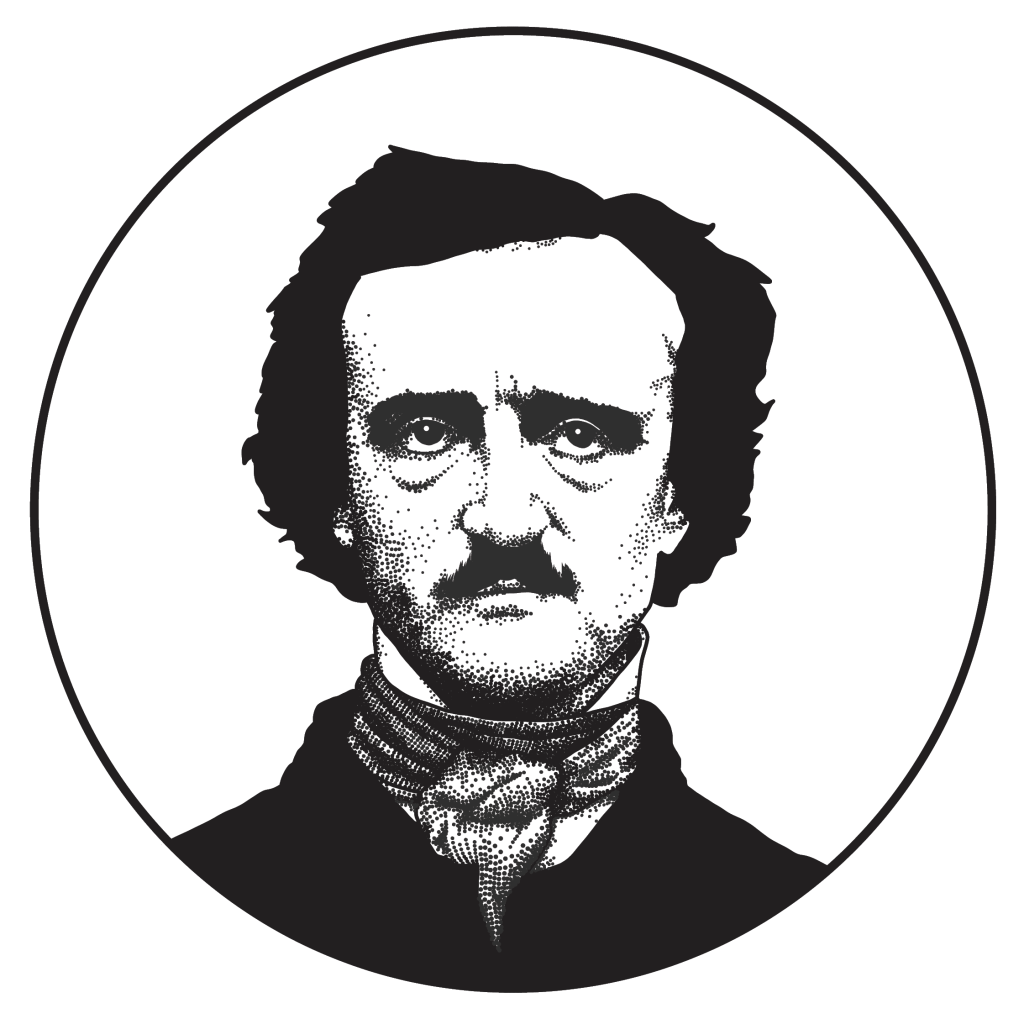
Edgar Allan Poe
(1809−1849)
Edgar Allan Poe was ahead of the scientists. In the poem Eureka, he put forth his vision of the evolution of the universe and the corresponding solution to the photometric paradox.
Edgar Allan Poe’s Insights into the Photometric Paradox
There was a lot to appreciate! Behind long and confusing metaphysics, there emerged a coherent picture of an evolving universe. The enumeration of the author’s revolutionary ideas alone causes not just admiration but superstitious awe — he must have known something others didn’t! Judge for yourselves: the explosive birth of the universe from its initial super-compact state, large-scale isotropy (that is, homogeneity), repulsive forces that existed in the early stages of development — all these are the postulates of modern-day cosmogony! Among the insights of Edgar Allan Poe was the solution to the photometric paradox, which scientists would discover only later.
However, a poem in prose and a scientific theory are very different matters, so contemporary scientists simply did not take notice of Poe’s ingenious conjectures. Only a century later, such leading figures as Arthur Eddington and Albert Einstein paid homage to Eureka, recognizing it as “a very beautiful achievement of an extraordinary independent mind.” In 1994, the Italian astronomer Alberto Cappi wrote a paper on the scientific components of the prose poem.
There Is a Solution!
The work of the German astronomer Johann Mädler in a way had the same destiny as Eureka, and only the support of the authoritative scientist William Thomson (Lord Kelvin) forced the scientific community to pay attention to Mädler’s conclusions. In 1861, while serving as a professor of astronomy at the Russian Imperial University of Dorpat (now the University of Tartu, Estonia), he wrote:“The world is created and hence it is not eternal… In the finite amount of time it could travel before it reaches our eye, a light beam could pass through only a finite space no matter how great the speed of light. If we knew the moment of creation, we would be able to calculate its boundary.”
In 1901, William Thomson, the first scientist in history to be granted the right to sit in the House of Lords of the British Parliament, provided a mathematical substantiation of Mädler’s theory. His conclusion was this: in view of the limited speed of light, the radiation of distant stars had not yet reached the Earth. In order for the Chéseaux-Olbers paradox to be possible (that is, for the sky to be flooded with the brightest light), the age of the universe must exceed…trillions of years! Only then the light from the myriad of distant stars will have time to reach the Solar System.
By and large, we live inside a cyclopean time machine. The dark night sky portrays the distant past, a message from those times when there were no stars or galaxies yet.
                </blockquote>
    <h3>Peering into the Depths of Time with Distant Starlight</h3>After all, we even see our Sun the way it was eight minutes ago. Those suns whose light falls on our planet are too few to fill the sky with blinding radiance. Only recently, 13.4 billion years along the road, did we observe the galaxy GN-z11 in the constellation Ursa Major. We see it as it was 400 million years after the Big Bang, during the infancy of the universe. The protogalaxy UDFj-39546284 in the constellation Fornax, discovered in 2011 as a result of data processing by the Hubble Ultra Deep Field program (2003–2004), is an even more distant object, and we observe it today in the state it was in 380 million years after the Big Bang.</p>
        <h3>How to Solve the Paradox
The age of the universe and the speed of light are finite. Light will reach us from the borders of the observed cosmos around 13.7 billion years after the birth of the universe. The stars were formed 200 million years after the Big Bang, so the light from very distant stars has not yet made it to Earth. This reasoning does not contradict the infinity of the universe: only that which can be observed is finite (because of the speed of light).
What’s Next?
Is there anything further away? Of course. The same galaxies that were once a gigantic 13.5 billion years from us have managed to “run away” a fair distance since. GN-z11 is currently estimated at 32 billion light-years away (taking into account the cosmological expansion), and our distant descendants will never see its light, as much as they might like to.
The sky is also made darker because of the redshift — an effect associated with the expansion of the universe: the emission spectrum of moving objects shifts to the long-wavelength region, and the faster the star retreats, the redder it looks. When the “mechanics” of the redshift were discovered, the question arose: could it have something to do with the photometric paradox? After all, most galaxies have such a large shift towards the infrared region of the spectrum that they become invisible. But as calculations showed, the role of the redshift is not very influential and does not exceed a third of the value for the stationary universe.
The Distant Future and the Cosmological Horizon
There’s another interesting result based on the Hubble law (which connects the distance to an object with its recession speed): if the galaxy is at a distance of the Hubble radius (approximately 13.8 billion light-years), then its speed is equal to the speed of light, and the radiation drops to zero. This radius is called the cosmological horizon, and everything that is behind it is not accessible. In the far-distant future, when, due to the expansion of the universe, most of the currently visible objects will make their way out, the sky will turn totally black. However, by then, our descendants will have come up with some newfangled way to keep the stars in the night sky.
Did you like the post? We invite you to read our other topics in Education category.
Follow us on Instagram.
<svg xmlns="http://www.w3.org/2000/svg" xmlns:xlink="http://www.w3.org/1999/xlink" id="Layer_1" x="0px" y="0px" viewBox="0 0 597.03 475.39" style="enable-background:new 0 0 597.03 475.39;" xml:space="preserve"><style type="text/css"> .st0{clip-path:url(#SVGID_00000021828697454809692600000004318893268413411000_);fill:#54A7B7;}</style><g> <defs> <rect id="SVGID_1_" x="63.22" y="2.39" width="470.59" height="470.65"></rect> </defs> <clipPath id="SVGID_00000125586198135712050590000014503595150480814249_"> <use xlink:href="#SVGID_1_" style="overflow:visible;"></use> </clipPath> <path style="clip-path:url(#SVGID_00000125586198135712050590000014503595150480814249_);fill:#54A7B7;" d="M352.92,237.74 c0-30.06-24.38-54.38-54.38-54.38c-30.06,0-54.38,24.32-54.38,54.38c0,30.01,24.32,54.38,54.38,54.38 C328.54,292.12,352.92,267.74,352.92,237.74 M440.15,237.74c0,78.06-63.55,141.62-141.62,141.62 c-78.12,0-141.62-63.55-141.62-141.62c0-78.12,63.5-141.62,141.62-141.62C376.6,96.12,440.15,159.61,440.15,237.74 M533.83,237.74 c0-129.78-105.58-235.3-235.3-235.3c-129.78,0-235.3,105.52-235.3,235.3s105.52,235.3,235.3,235.3 C428.26,473.03,533.83,367.51,533.83,237.74"></path></g></svg>