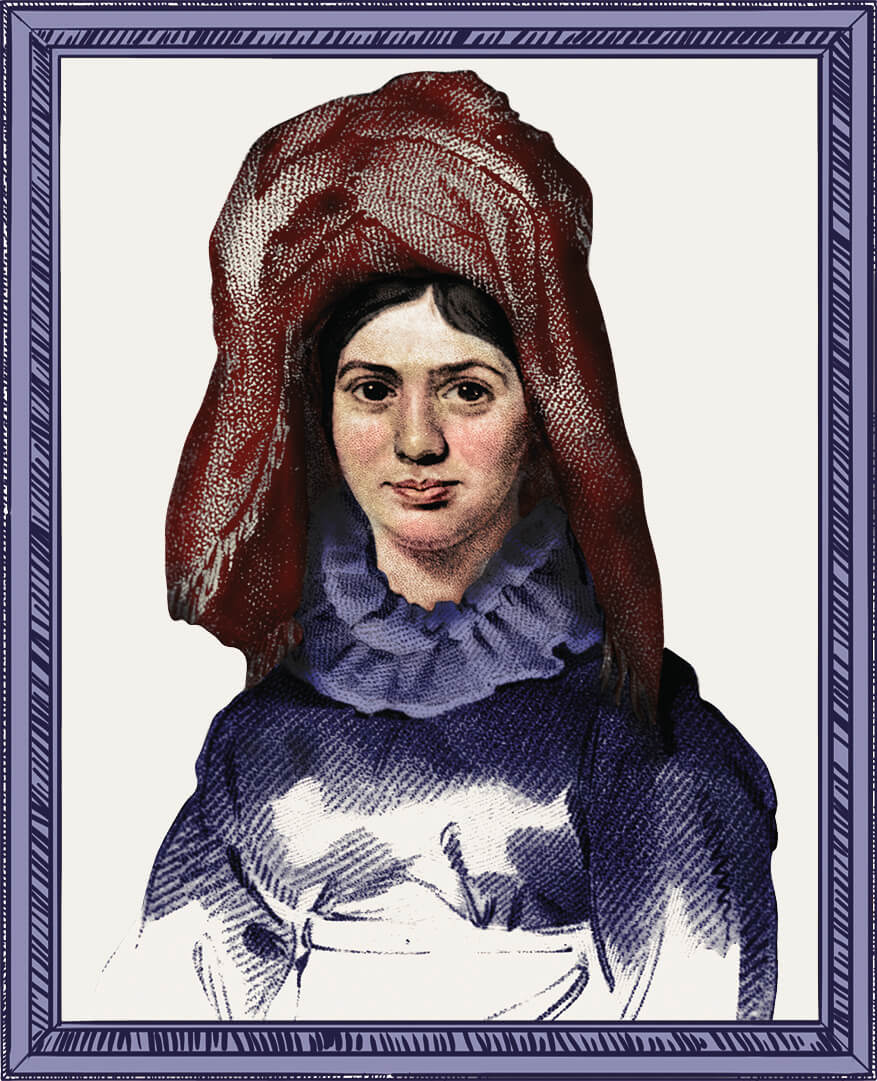
artist Nathan Cooper Branwhite (1817)
A Stranger Appears
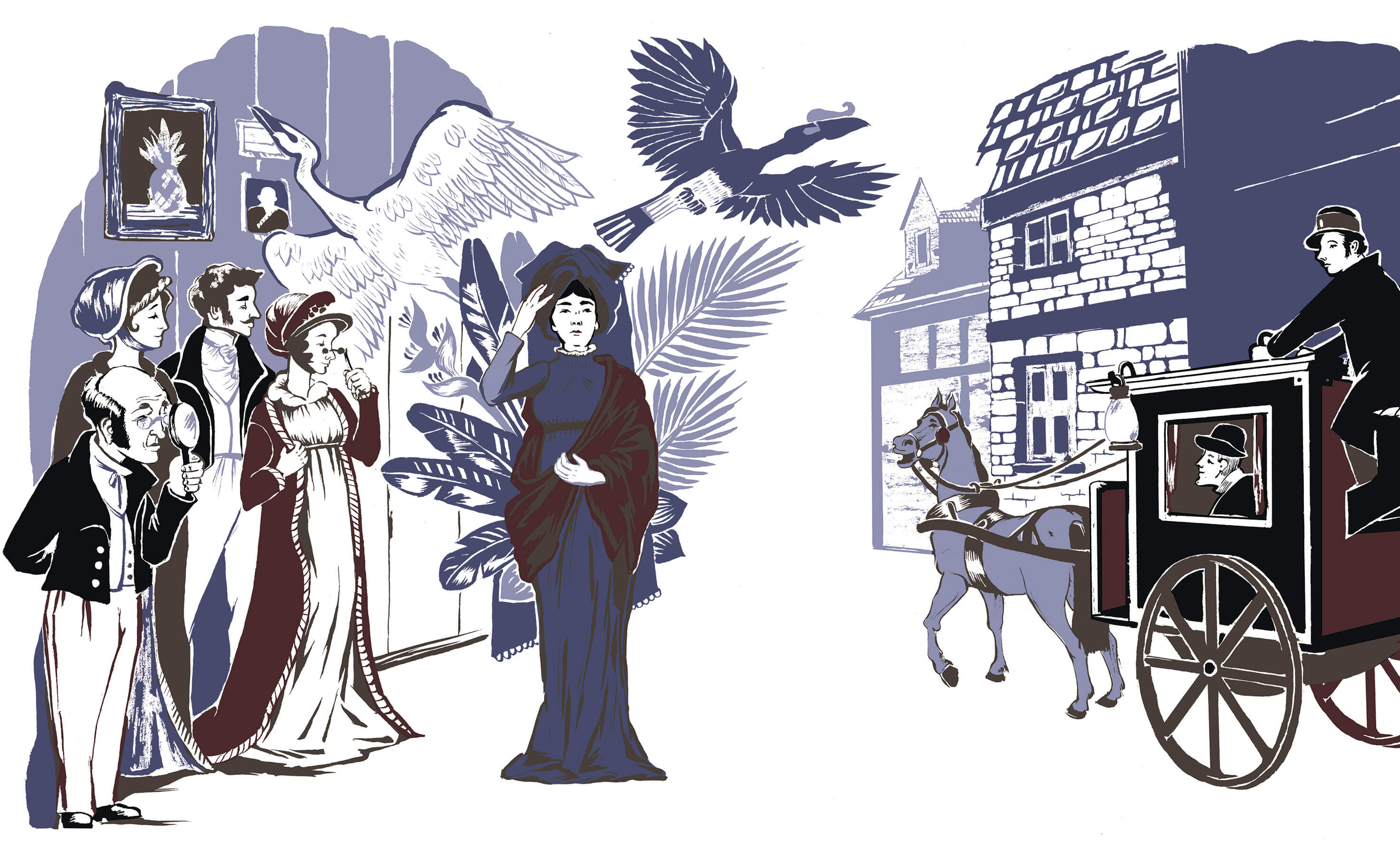
The story begins in Gloucestershire, England, in the year 1817. A young woman, wearing a strange dress and speaking a language that no one could understand, was found wandering the streets of a small village near Bristol. There were no documents or records to help identify the stranger. The villagers attempted to figure out her name through gestures. In response, the stranger kept pointing to herself and exclaiming, “Caraboo!”
The magistrate of Bristol gave the young woman a room. Rumors about her mysterious origins began to spread throughout England, infused with intriguing tidbits: she regularly prayed, bowing down before an unknown deity, refused to drink tea twice from the same cup, and tried to sleep on the floor instead of the bed that was provided to her.
Efforts to Unveil Princess Caraboo’s Mysterious Origins
Concerned members of the public tried to identify the woman’s home country, showing her illustrated books with pictures of foreign lands, but she didn’t recognize any of them, except for a few Chinese paintings and statues. However, she didn’t look like she came from China: she had European features, and her feet were not bound according to Chinese custom. The villagers eventually decided that the woman must have visited China on her journey. She seemed to indicate that she traveled by ship from the south.
Upon seeing a still life painting of a pineapple, Caraboo grew excited and exclaimed repeatedly: “Anana! Anana!,” pointing to the fruit. Evidently, the fruit was familiar to her, so people assumed that pineapples grew in her homeland.
In the case of a pineapple, this adventuress quickly grasped the idea without any special training. In English, the fruit is called “pineapple,” but in many other languages, it is called “ananas” This is no coincidence: languages often borrow words from each other (for example, the word ananas originally comes from the Tupi language). Caraboo could only speak English and knew a few words from other languages, so she couldn’t have known much about the linguistic process of borrowing, but she guessed correctly.
                                                <img width="768" height="614" src="https://oyla.us/wp-content/uploads/2023/11/img03-2.jpg" alt="An image of a ship in the ocean with words written on it." />
    <p><b>The woman convinced not only the romantically-inclined residents of Bristol but also the most skeptical of pundits. </b><b>Why?</b></p>
        <h2>Her Lost Majesty</h2>
    <p>Newspapers began to circulate the story of Caraboo, attracting many curious polyglots and travelers to the magistrate’s house. One of them suggested that Caraboo was not a name but the woman’s birthplace. Another noted that her mannerisms resembled those of Circassian women, although neither her clothes nor her language appeared to be Circassian.
The more people talked to the mysterious stranger, the more complicated the situation became. Her speech incorporated Romani, Malay, and Arabic words, as well as words whose origins could not be determined. And Caraboo didn’t just speak an unknown language; she also wrote in it. The symbols she used resembled Chinese, Arabic, and Hebrew scripts.
Caraboo’s speech was not just a combination of incoherent sounds — she had invented an original language with its own vocabulary and pronunciation rules. One of her visitors, Dr. Wilkinson, set out to study her language. Throughout their sessions, Caraboo’s accent remained consistent, and she never confused the meanings of the words she used.
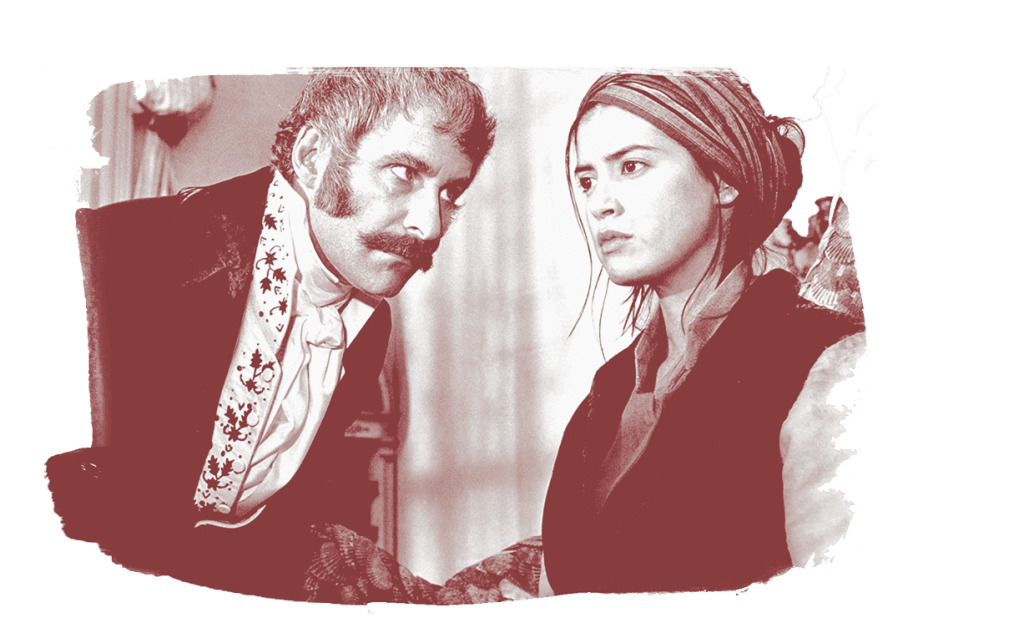

Stills from the film Princess Caraboo (1994). The role of Mary Wilcox-Baker was played by Phoebe Cates.
The Romani words Caraboo used were coin names, but Allah Tallah, the name she had given to her invented god, was most likely adopted from a Muslim native of the Middle East.
The Arrival of Manuel Eynesso
One day, a sailor named Manuel Eynesso came to town. He claimed that he understood the woman’s language and even translated her story. According to him, Caraboo was no ordinary stranger but a highborn lady from the island of Javasu who had been abducted by pirates. Apparently, after a long voyage on their ship, she could not stand the torment of captivity and jumped overboard somewhere off the coast of England. She had swapped her expensive clothes for food and woolen clothes, and that’s when she was eventually found.
It’s not clear whether this sailor was acting as Caraboo’s accomplice or had devised his own scheme. In any case, the “princess” played her role flawlessly and remained nonchalant, even if she was caught off guard by the sudden emergence of a person who “understood” the language known only to her.

Speaking Truthfully
Talent and attention to detail played a cruel joke on the impostor. Dr. Wilkinson was so passionate about learning the language and customs of the island of Javasu that he published several articles about the topic in local newspapers and magazines, accompanied by Caraboo’s portrait made by a London artist.
Thanks to this picture, a woman named Mrs. Neale identified the self-proclaimed “princess” as the woman who had once rented a room in her boarding house. So who was the woman masquerading as Caraboo? She was Mary Wilcocks-Baker, the daughter of a Devonshire cobbler. It turned out that, from a young age, she had disliked hard work and had always had a fruitful imagination.
Mary had worked as a maid and nanny in many different households but never managed to keep the job. She had made friends with a Jewish family, studying their culture and the Hebrew alphabet. Later, she lived in a Roma community and borrowed a few words from their language. Based on this fragmentary knowledge, Mary invented her own language and even spoke it with her friends.
Mary’s Transformation into Princess Caraboo
One day, after seeing how courteously men behaved towards French women, Mary decided to pretend to be a French foreigner. However, her pursuits didn’t get her very far: she ended up in the company of an actual Frenchman. The novice con artist pretended it was a misunderstanding and that she, in fact, was Spanish, but soon she met a person who knew that language, too. That’s when it occurred to her that she’d have more luck impersonating a native of a distant or, better yet, fictional country.
The most incredible thing about this story is how quickly Mary adapted to her circumstances and memorized new information. When other people assumed that the “princess” did not understand English, they discussed all kinds of topics right in front of her, including the customs of foreign countries. One of the travelers noted that in the Pacific Islands, it was customary to greet people by putting a hand to the head — so Caraboo immediately began to greet people this way. From all the books other people had shown her, Mary learned various foreign writing systems and imitated them.
The magistrate’s family, who had given shelter to the woman, was perplexed and thought it best to send Mary off as far away as possible — to America. In a few years, the “princess” returned to her native England but never managed to regain her past success.
        <h2>What Did We Learn from the Story of Princess Caraboo?</h2>
    <p>In linguistics, languages like Mary’s are called <b>artificial</b>. They do not originate from natural human communication but rather are created for a specific purpose: scientific recording of data, programming, international communication, or just for fun. Typically, such a language is created by one person or a small group. However, if a language is not spoken by other people other than the author themselves, then we are not talking about a language but a linguistic project.</p>
                                                <img width="768" height="586" src="https://oyla.us/wp-content/uploads/2023/11/ill02-1-768x586.png" alt="An illustration of a woman in a purple dress with a book in front of her." srcset="https://i0.wp.com/oyla.us/wp-content/uploads/2023/11/ill02-1.png?resize=768%2C586&ssl=1 768w, https://i0.wp.com/oyla.us/wp-content/uploads/2023/11/ill02-1.png?resize=300%2C229&ssl=1 300w, https://i0.wp.com/oyla.us/wp-content/uploads/2023/11/ill02-1.png?resize=1024%2C781&ssl=1 1024w, https://i0.wp.com/oyla.us/wp-content/uploads/2023/11/ill02-1.png?resize=1536%2C1171&ssl=1 1536w, https://i0.wp.com/oyla.us/wp-content/uploads/2023/11/ill02-1.png?resize=2048%2C1561&ssl=1 2048w, https://i0.wp.com/oyla.us/wp-content/uploads/2023/11/ill02-1.png?resize=1200%2C915&ssl=1 1200w, https://i0.wp.com/oyla.us/wp-content/uploads/2023/11/ill02-1.png?w=1600&ssl=1 1600w, https://i0.wp.com/oyla.us/wp-content/uploads/2023/11/ill02-1.png?w=2400&ssl=1 2400w" sizes="(max-width: 768px) 100vw, 768px" />
                                                <img width="800" height="523" src="https://oyla.us/wp-content/uploads/2023/11/img06-3.jpg" alt="Princess Caraboo | Lord of the rings vs lord of the rings vs lord of the rings vs lord." />
    <p><b>So how do you come up with a language</b><b> if you don’t have a phenomenal memory and linguistic flair like Mary Wilcocks-Baker? Arm yourself with knowledge!</b></p><h3>Understanding Artificial Languages: A Priori vs. A Posteriori</h3><p>Linguists divide artificial languages into <em><strong>a priori</strong></em> and <em><strong>a posteriori</strong></em> depending on the language’s origin. These names come from the Latin expressions which mean, respectively, “knowledge obtained before experience” and “knowledge gained after experience.” What does this have to do with linguistics? Scientists use the terms to indicate whether a language is based on existing linguistic constructions or whether it is an invented system.
As we already know, Princess Caraboo’s language contained many borrowed words, and its writing imitated symbols she had seen in foreign texts. This makes it an a posteriori language. For example, the a priori Klingon language, developed specifically for the Star Trek series, has no similarities with almost any known natural language.
Many artificial languages are created for fictional purposes so that the writer can bring a fantasy world to life. For example, J. R. R. Tolkien constructed an entire family of Elvish languages, while George R. R. Martin defined the Dothraki speech only in the most general terms on the pages of his famous series, A Song of Ice and Fire. The Dothraki linguistic system, including phonetics and grammar, was created specifically for the Game of Thrones television series. In 2014, the HBO network helped launch an online course and accompanying textbook designed for learners of the Dothraki language.
Start with phonetics. Each language uses a specific set of sounds. How many vowels do you have? Consonants? How do they fit together? And how many syllables can there be in one word? Is there lexical stress in your language, and how is it used? The answers to these questions will provide the foundational rules that you can use to come up with your own words and sentences.
Creating a Comprehensive Writing System for Your Constructed Language
Unless you’re creating a language for an isolated tribe, it has to have a writing system. You can use an established alphabet and add extra elements to the existing letters or design your own script. The most important thing is to do everything scientifically, choosing a separate sound for each symbol or a combination of symbols. Do not forget that writing is used to represent spoken speech with inscriptions. So, every sound that you create (see the previous paragraph) has to correspond at least to one symbol.
It’s time to make up words! Start with the simplest and most commonly used words, such as “I,” “you,” “to be,” “mother,” “family,” “to love”… Divide words into semantic groups: numbers, names, names of geographic objects, animals, prepositions, interjections, and so on. Each word should fit into the framework of the phonological rules you’ve invented.
All done? Not yet! Language is not merely a collection of words. The words need to be combined according to a specific system, which in linguistics is called grammar. How is the plural form made in your language? How many tenses do your verbs have?
Practice. Unless you want your language to be a heap of words scribbled in notebooks and stuffed away in a drawer, use it! Achieve fluent pronunciation. Teach your language to your friends. Start translating poems. The main thing is to have fun!
Post on topic: Princess Caraboo
Did you like the post? We invite you to read our other topics in Education category.
Follow us on Instagram.
<svg xmlns="http://www.w3.org/2000/svg" xmlns:xlink="http://www.w3.org/1999/xlink" id="Layer_1" x="0px" y="0px" viewBox="0 0 597.03 475.39" style="enable-background:new 0 0 597.03 475.39;" xml:space="preserve"><style type="text/css"> .st0{clip-path:url(#SVGID_00000021828697454809692600000004318893268413411000_);fill:#54A7B7;}</style><g> <defs> <rect id="SVGID_1_" x="63.22" y="2.39" width="470.59" height="470.65"></rect> </defs> <clipPath id="SVGID_00000125586198135712050590000014503595150480814249_"> <use xlink:href="#SVGID_1_" style="overflow:visible;"></use> </clipPath> <path style="clip-path:url(#SVGID_00000125586198135712050590000014503595150480814249_);fill:#54A7B7;" d="M352.92,237.74 c0-30.06-24.38-54.38-54.38-54.38c-30.06,0-54.38,24.32-54.38,54.38c0,30.01,24.32,54.38,54.38,54.38 C328.54,292.12,352.92,267.74,352.92,237.74 M440.15,237.74c0,78.06-63.55,141.62-141.62,141.62 c-78.12,0-141.62-63.55-141.62-141.62c0-78.12,63.5-141.62,141.62-141.62C376.6,96.12,440.15,159.61,440.15,237.74 M533.83,237.74 c0-129.78-105.58-235.3-235.3-235.3c-129.78,0-235.3,105.52-235.3,235.3s105.52,235.3,235.3,235.3 C428.26,473.03,533.83,367.51,533.83,237.74"></path></g></svg>