
Let’s start with a simple example. We often try to convey a certain message to the other person, but it can be challenging to do so. That’s when we resort to examples/counterexamples. We may say, “Women are capable of playing chess just as well as men. For example, the Hungarian chess player Judit Polgar won against the leading grandmasters and for a long time was ranked in the top ten of the world’s chess players.” If it were not for the specific example, the other person could easily answer: “No, I think otherwise.” But you have to agree that your argument sounds a lot more convincing when you back it up with an example.

Now consider a different scenario: your friend tells you that all soccer players are blond. How can you prove them wrong? The most sensible thing to do is provide a counterexample. Why? Because a single counterexample outweighs a thousand examples in favor of the original argument.

Your friend may list dozens of blond soccer players, but you put an end to the dispute once you mention, for instance, the dark-haired Lionel Messi. Similarly, counterexamples hold a special place in solving mathematical problems. Do you still have doubts? We will prove you wrong.
PROBLEM 1 | Counterexample
IS THERE A NUMBER THAT HAS THE SAME NUMBER OF LETTERS IN ITS WRITTEN NAME AS DIGITS?
Of course, it all depends on the language. But how can we begin solving the problem? Should we check every single number? Doing it that way, we might have to count to a million… Wait a minute! The word “million” has exactly 7 letters, and it takes 7 digits to write: a one and 6 zeros.
Notice that one example is enough to solve this problem. But you might be wondering if a single counterexample is really sufficient. Well, suppose the number 10 does not fit our criteria. So what? It doesn’t mean that there are no numbers that have the same number of letters in their written name as digits.
We don’t have to answer the question of “How do we find the number?” We have a succinct solution to our problem: “Yes, for example, a ‘million.’” Constructing a counterexample is a common way of refuting a hypothesis, and you can easily transform the original problem into a hypothesis to solve it.
PROBLEM 2
CAN THE SUM OF a) TWO INTEGERS, b) THREE INTEGERS, c) MORE THAN ONE HUNDRED INTEGERS BE EQUAL TO THE PRODUCT?
Let’s start with the first part of the problem. It’s pretty easy to come up with an example: say, 0 and 0. Notice that everything which is not forbidden is allowed. So the digits can be zeros . Each and every one of them! Since the same reasoning applies to the remaining parts of the problem. Let’s exclude the possibility of all the numbers being zeros.
So, from now on, we work exclusively with natural numbers. The first part is not at all tricky — many of you have probably already guessed the answer: 2 and 2. Interestingly, this is the only example, but luckily, we do not have to prove it.

Counterexample | Exception
But there is an exception to this rule: if the number we add or multiply by is 1, then the product will remain the same, while the sum will increase by 1. This observation is critical to the solution. Consider, for example, the numbers 10 and 20. Their addition yields 30, and the product is 200. This is where mathematical magic happens! By adding the number one 170 times to the sum, we raise it to 200. Similarly, multiplying the product of 10 and 20 by one 170 times, we still get 200. Therefore, both the sum and the product equal 200.
                                                <img width="407" height="163" src="https://oyla.us/wp-content/uploads/2023/08/image-2-1.png" alt="The counterexample to the statement that the sun of three numbers equals the product." />
    <p>As for the second part, it’s just as easy to come up with an example: “<b>1, 2, 3.</b>” Herein lies an important lesson: when you look for examples, start with simple ones. In the case of numbers, go from the smallest up.
Now, on to the third part. First of all, let us note something curious: usually, the product of numbers is much greater than the sum. To prove this notion, consider the operation of addition. When we add a positive integer X to a set of other integers, the sum just increases by X. However, in multiplication, the product is increased X-fold. That’s why it is greater than the sum.

Examples and how to solve them
But there is an exception to this rule: if the number we add or multiply by is 1, then the product will remain the same, while the sum will increase by 1. This observation is critical to the solution. Consider, for example, the numbers 10 and 20. Their addition yields 30, and the product is 200. This is where mathematical magic happens: by adding the number one 170 times to the sum, we raise it to 200. Similarly, multiplying the product of 10 and 20 by one 170 times, we still get 200. Therefore, both the sum and the product equal 200.
Pay attention to the steps we took to solve the last problem. First, we recognized something that stood out to us, then we found a way to keep the product from increasing. Then finally constructed a suitable example. Notice that there is nothing special about the numbers 10 and 20; any others would also fit. Well, almost any: if we take 10 and 10, then to make the sum (20) equal to the product (100), we will need 80 ones, which means that there will be fewer than 100 numbers in total.
PROBLEM 3
REAL MADRID HAS WON THE MOST VICTORIES IN SPAIN’S PROFESSIONAL FOOTBALL LEAGUE, WHICH HAS A TOTAL OF 20 TEAMS PARTICIPATING. COULD IT HAVE COME IN LAST AT THE SAME TIME?
Much like the previous problem, the question may seem absurd at first glance. If one team has won more often than the other teams, how can it be last — that is, score the least number of points? In other words, how could other teams score more points if they have fewer victories? The only logical answer is a draw. This hypothesis will help us to construct an example.
Suppose that Real Madrid hasn’t won many games. Maybe it was victorious only once. Well, in this case, the rest of the teams should have zero wins since they will be defeated by Real Madrid, as the problem states. This means that all their games with Real Madrid have resulted in draws, which should give Real Madrid lots of points for the draws. This doesn’t work.
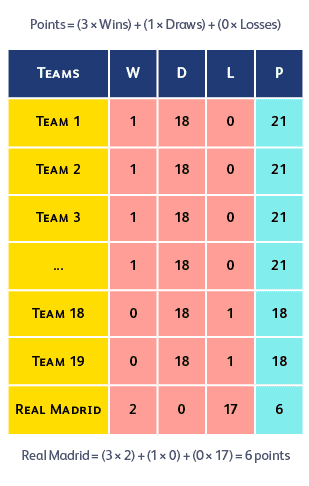
Moving on. Suppose Real Madrid has had two wins. So, the rest of the teams could have won one game each against Real Madrid — all except the two teams that lost to them. Suppose their matches ended in a draw. In this case, Real Madrid would have scored 6 points, while the other teams would have had at least 18 points thanks to multiple draws.
PROBLEM 4 | Counterexample
CAN THE PRODUCT OF THE DIGITS OF A FOUR-DIGIT NUMBER BE EQUAL TO A) 12, B) 22?
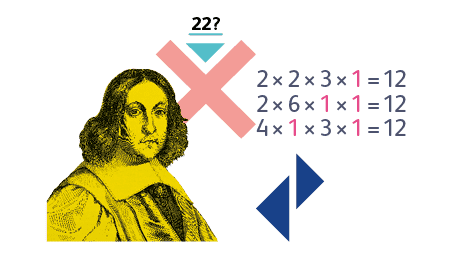
For the first part of the question, one example is enough: 2231. How did we get this answer? We decomposed 12 as a product of 2, 2, and 3, and then, since the number must have four digits, we added 1 so that the resulting product wouldn’t change. There are other examples as well: 2611, 4131, etc.
For the second part, one example is also enough — except, it does not exist. In general, this is the most challenging aspect of problems like this: we can’t always be certain that such an example even exists! You can spend a lot of time looking for what isn’t there. Therefore, we suggest that if you’re not sure about the answer to whether something is possible, try looking for examples for and against the argument.
How to solve a problem?
In this problem, the desired number does not exist. However, the fact that we did not come up with an example is not in itself a strong enough argument: chances are that we just haven’t found it yet. So, we need proof. In this case, it goes as follows: 22 is the product of 2 and 11, and 11 is a prime number. This means that the product of the digits of the required four-digit number should be divisible by 11, which means that one of the digits must be divisible by 11, which is impossible, since the largest digit is 9. To be more precise, it’s possible if one of the digits is 0, but in such a case, the product will be 0, not 22.
So, we have proven that it is impossible to get 22. But let us repeat once again: the fact that we could not construct an example does not prove the absence of a solution. By the way, this more or less was the essence of Fermat’s famous theorem: the great mathematician proposed that there are no positive integers x, y, z, and an integer n > 2 that satisfy the equation xn + yn = zn. For many years, no one could come up with a counterexample, but this alone did not prove the validity of Fermat’s theorem.
PROBLEM 5
ARE THERE INTEGERS X, Y, AND Z SO THAT 28X + 30Y + 31Z = 365?
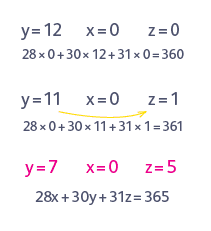
This problem can be solved in multiple ways. It’s clear that a single example is enough, but how do we find it? Let’s reason like this: the numbers on the left are close to 30, which means that they should be added approximately 12 times to get the sum of 365. Suppose that y = 12, x = z = 0. Then the left side will be equal to 360. Now, let’s move 1 digit from y to z. In this case, we subtract 30 from the left side of the equation and add 31, with the end result that we added 1 to the total. After performing this operation five times, we achieve the desired solution: x = 0, y = 7, z = 5.
Another solution
You can try it another way. Since the number on the right side of the equality ends with 5, the number on the left should end with 5 as well. It is clear that 30 y does not a ect the last digit, that is, you need to get 5 using either 28 x or 31 z. The easiest way is to try z = 5, so that 31 z = 155. All that’s left to do is add 210 — we can do this by using y = 7, which leads us to the same solution: x = 0, y = 7, z = 5.
That’s all well and good, but is it really the most elegant solution?
Let’s take another look at the problem. The coefficients are 28, 30, and 31, and on the right side, we have 365. Does it remind you of anything? This is exactly the number of days in months and a year! So if we count how many months in a year have 28 days (1), how many have 30 days (4), and how many have 31 days (7), we arrive at an elegant solution: x = 1, y = 4, z = 7. However, this did not discredit our previous solutions.
Let’s sum it all up. If a problem asks us if something is possible, whether it exists, and so on, the answer “yes” needs to be illustrated with just one example. But the answer “no” requires solid proof. The same is true for counterexamples.
Post on topic: Counterexample | The Importance in Making Arguments
We invite you to read our other topics in Education category.
Follow us on Instagram.
<svg xmlns="http://www.w3.org/2000/svg" xmlns:xlink="http://www.w3.org/1999/xlink" id="Layer_1" x="0px" y="0px" viewBox="0 0 597.03 475.39" style="enable-background:new 0 0 597.03 475.39;" xml:space="preserve"><style type="text/css"> .st0{clip-path:url(#SVGID_00000021828697454809692600000004318893268413411000_);fill:#54A7B7;}</style><g> <defs> <rect id="SVGID_1_" x="63.22" y="2.39" width="470.59" height="470.65"></rect> </defs> <clipPath id="SVGID_00000125586198135712050590000014503595150480814249_"> <use xlink:href="#SVGID_1_" style="overflow:visible;"></use> </clipPath> <path style="clip-path:url(#SVGID_00000125586198135712050590000014503595150480814249_);fill:#54A7B7;" d="M352.92,237.74 c0-30.06-24.38-54.38-54.38-54.38c-30.06,0-54.38,24.32-54.38,54.38c0,30.01,24.32,54.38,54.38,54.38 C328.54,292.12,352.92,267.74,352.92,237.74 M440.15,237.74c0,78.06-63.55,141.62-141.62,141.62 c-78.12,0-141.62-63.55-141.62-141.62c0-78.12,63.5-141.62,141.62-141.62C376.6,96.12,440.15,159.61,440.15,237.74 M533.83,237.74 c0-129.78-105.58-235.3-235.3-235.3c-129.78,0-235.3,105.52-235.3,235.3s105.52,235.3,235.3,235.3 C428.26,473.03,533.83,367.51,533.83,237.74"></path></g></svg>