Post on topic: What a vaccines?
History
Relatively frequently, even the most prosperous of human societies could be practically destroyed in a moment. The main reason for this were epidemics. Illnesses mowed down millions of people and emptied entire cities, and even more terrifyingly: there was no way to ward off infection.
Physicians long understood that patients who had survived an epidemic seldom experienced the same illness a second time. It was as if their bodies “memorised” the illness they experienced and learned how to defend themselves against it. Doctors, using this knowledge, began trying to infect patients with lighter forms of dangerous illnesses in order to pass on these defences.
This was quite simple to do with smallpox, a disease that ravaged the global population for thousands of years. Over the course of this mortally dangerous illness, many liquid-filled pustules appeared across the body of the patient. If the contents of one of these sores were put into a fresh wound on another person’s body, the second individual would contract a lighter form of smallpox and be defended from future infection.
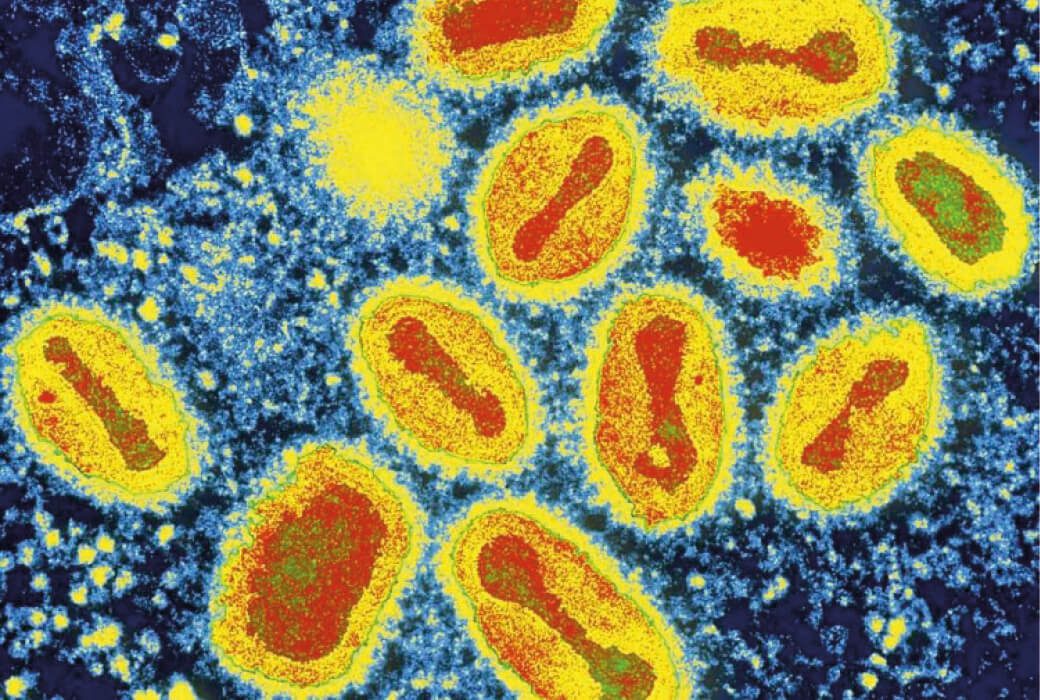
This procedure was first employed in India over a thousand years ago, and word about the healing powers of the pockmarked bubbles spread from there to China and the Middle East. A description of the technique appears in the works of the famous Persian physician Avicenna. In Europe, it was called “variolation” in honor of the Latin name of the disease: variola.
However, variolation was not widespread. Despite the obvious positive effect, the procedure was still quite dangerous — in fact, in the process of infecting healthy people with a dangerous disease, some of the vaccinated ended up dying. The world needed an adequate alternative.
The Discovery of Vaccination
And so a new approach was found. The English doctor Edward Jenner, who studied traditional medicine, became the developer of the world’s first vaccine against smallpox. In those days, in addition to human smallpox, cowpox was common, though it posed no threat to humans. It left only light scars from pustules on the hands. Most importantly, those who had recovered from cowpox rarely became ill with smallpox. This fact drew the attention of the observant physician. Jenner studied this phenomenon for many years and, finally, decided to conduct a public experiment, infecting a young boy with cowpox from an afflicted milkmaid. After some time passed and his symptoms had subsided, Jenner attempted to infect the boy with smallpox, but the disease did not take hold. From that time on, this method, called “vaccination” by its creator (from the Latin vacca, or “cow”), began to be used widely around the world.
Vaccines | Fighting Infection
But how can an illness protect us? To understand the principle of how vaccines work, we must look at the workings of our immune system. Overall, a person has two lines of defence that help them to manage disease in different ways.
The first line is what we call congenital or innate immunity, the cells of which are located in all tissues in the body and are always ready to defend against invaders. They recognise “templates” of pathogens — various molecules that are not found in our body but that we encounter in bacteria, viruses, or fungi. When a pathogen is recognised, the innate immunity cells mobilise to destroy the infection, causing inflammation — a specific reaction to protect the body.
During inflammation, all “exits” from the infected area are blocked by blood and phagocytic cells (also known as “natural killer cells”), which recognise viruses, bacteria, and fungi and consume them. The injured skin is not the only part of the body that becomes inflamed. If bacteria enter the lungs, there can be inflammation there as well. Viruses and bacteria can also lead to a runny nose, caused by inflammation of the mucous membrane in the nose.

Edward Jenner (1749–1823) was an English doctor who developed the smallpox vaccine. In 1803, an institute of immunisation was founded, called the Edward Jenner Institute for Vaccine Research in his honour.

On May 14th, 1796, Jenner gave the first injected inoculation in history to an eight-year-old boy named James Phipps
Diagram of DR Edward Jenner’s Experiment
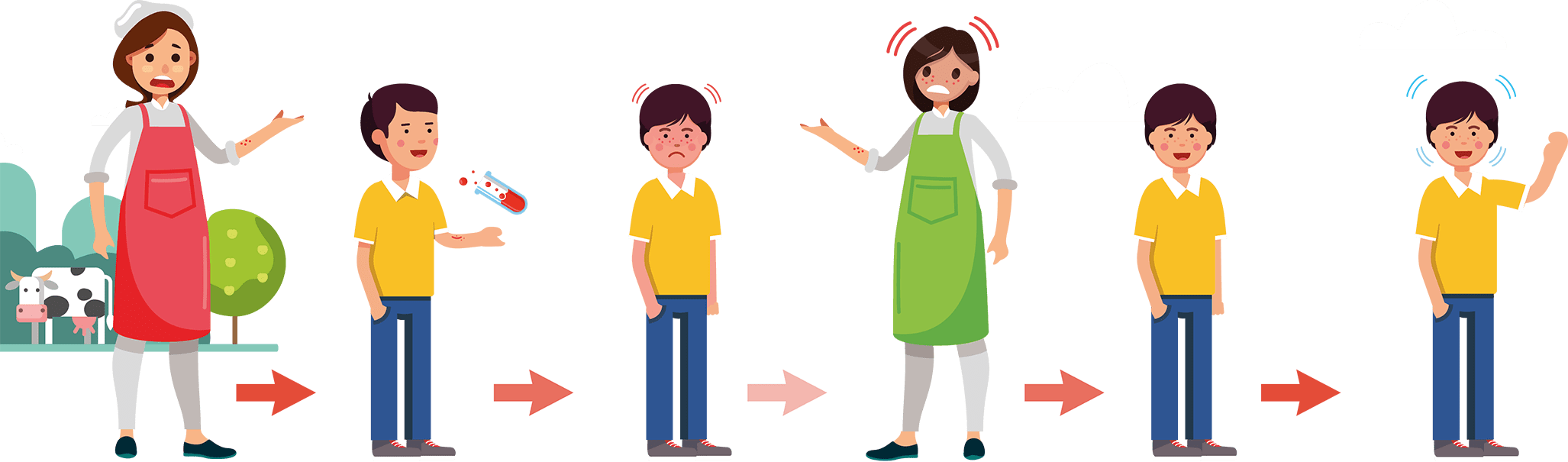
1. Milkmaid Sarah Nelmes was ill with cowpox
- The contents of a sore from Nelmes’ hand was rubbed into a scratch on James
- James experienced a mild illness that passed quickly
-
Jenner collected the contents of a sore from an individual infected with human smallpox
-
A month-and-a-half later, James was inoculated with human smallpox, but the disease did not develop
-
A few months later, a second inoculation of smallpox was carried out, but James still did not fall sick
An Inflammatory Reaction
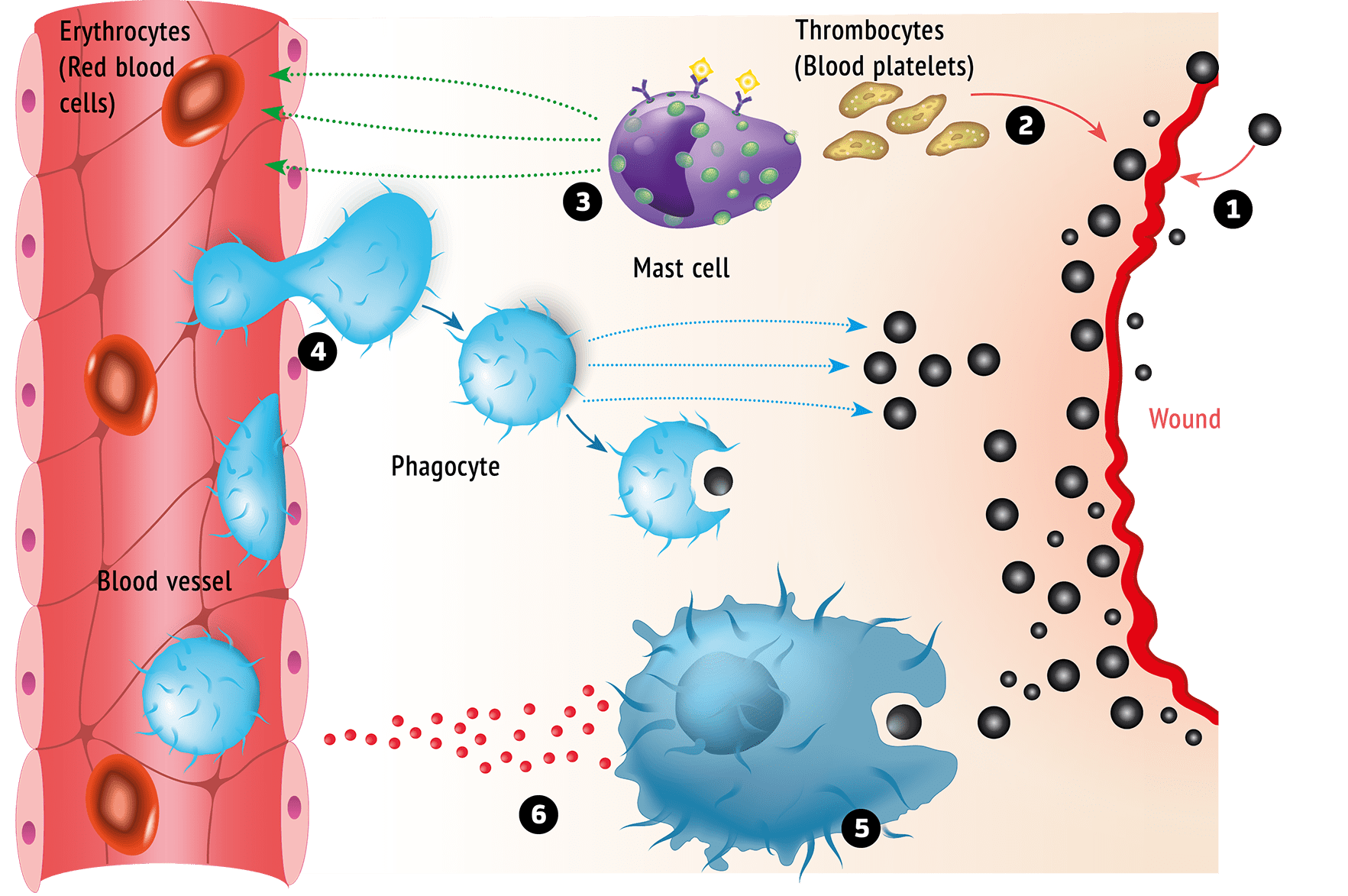
1. Bacteria infiltrate through a wound;
-
Blood coagulates around the wound;
3.During injury, the mast cell is activated. It releases substances that call for phagocytes. Blood vessels expand, increasing the flow of blood. The inflamed area swells and reddens;
- Phagocytes exit the blood vessel;
-
Phagocytes absorb and destroy the bacteria and dead cells (phagocytosis);
-
A chemical signal calls for the immune cells at the centre of the infection.
But inflammation is not a total defensce against infection. It acts indiscriminately and costs our system dearly. Inflammation can severely affect the conditions within tissues, and therefore our own cells suffer equally, if not more, than bacteria.
Furthermore, inflammation does not have an effect on the immune system’s “memory.” If the innate immunity successfully cleans the tissue of any infection, then after repeated infection, everything will have to start from the beginning again: damage to the tissue, fighting with pathogens, and so on. Many bacteria have learned to survive and even thrive in such conditions.
Vaccines | The Rise of Adaptive Immunity
In the process of evolution, we acquired a secondary defensce system, adaptive immunity, in order to specifically combat these sly enemies. In contrast to innate immunity, it is not present in all of our tissues but takes its aim specifically against aggressors. To do so, it adapts to the invaders, hence its name. The process of adaptation takes several days, forming an immunological memory: during a second attack, the enemy — bacteria or virus — will be destroyed in minutes, as soon as it comes knocking at the organism’s door.
Adaptive immunity cells are called lymphocytes and stay in the lymph nodes throughout the whole body. When innate immunity does not successfully fight off inflammation, it sends its own “messenger” to the nearest lymph node. This is a specializsed cell resembling a tree, so scientists call it dendritic (dendrite means “tree” or “sprout” in Greek). On its branches, it carries pieces of the proteins from organisms that caused the infection.
                <blockquote>
        <p>
            Vaccination (inoculation) is the creation of artificial immunity to prevent and reduce the negative consequences of a disease.

                </blockquote>
    <h3>The Life Cycle of Lymphocytes in Lymph Nodes</h3>Lymphocytes in lymph nodes collect around a dendritic cell and attach to its branches. A few days later, the “fighters” among the lymphocytes are selected. These fighter cells will recognizse and attack proteins. Then, immune cells undergo a kind of training. They divide and become larger — the lymph nodes swell not from inflammation, but because they are filled with their “army” of lymphocytes. After 3–4 days, some lymphocytes leave the lymph node and go to the infection site. From this moment, the pathogen’s days (more like hours) are numbered.
The lymphocytes, having arrived in the inflamed area, completely change the power balance in the fight. Some lymphocytes mercilessly destroy damaged cells in their own organism until there are no remnants of bacteria or viruses. A second group controls the inflammatory process and makes it more coordinated. The remaining group stays behind in the lymph nodes to fill the organism with molecules that “tag” pathogens so that immune cells can easily detect them.
The Work of Adaptive Immunity
The dendritic cell holds a part of the dead bacteria (the antigen) on its surface. The antigen interacts with the lymphocyte. The lymphocyte is activated and divides. After a few days, these “trained” lymphocytes are sent to the site of the infection.

How Do Vaccines Work?
Now we have all the knowledge necessary to understand how vaccines work. We explored how the inoculation of a healthy person with a weakened virus works. Now, knowing how innate and adaptive immunities work, we can return to the chain of events that occur for the body to protect itself from diseases.
Modern vaccines have two main components, which doctors call “antigens” and “adjuvants.”
ANTIGEN
An antigen is a weakened pathogen or its separate fragments. In some cases, an “alien” pathogen is used that possesses proteins similar to ours. For example, human tuberculosis is vaccinated with a bovine causative agent (for cows!). Sometimes, instead of whole pathogens, only their purified proteins are used. It is most important that the preparation “targets” the activation of adaptive immunity.
ADJUVANT
An adjuvant (from the Latin adjuvare, “to add” or “assist”) is a mixture of “danger signals” for innate immunity. As you may recall, innate immunity reacts to characteristic patterns of pathogens, and this reaction manifests itself in inflammation and the sending of the protein-loaded dendritic cells (in the case of vaccines, antigen-loaded) to the lymph nodes. To cause this reaction, we collect several bacterial templates and grind them into a fine dust. This mixture is called the adjuvant. When introduced into the body, it causes quite a strong inflammatory reaction, but an antigen is the only foreign protein that can be sent from this location to the lymph node.
Time elapsed from the detection of a pathogen until the creation of its vaccine


What happens when we introduce this mixture into, for example, a muscle? Innate immunity sends the information of the antigen to adaptive immunity. The latter prepares itself to counteract the pathogen, which is not in the body (only its proteins are there). As a result, immunological memory will be formed in the absence of a real disease. So, when a virus or bacterium actually invades, the body meets it fully armed and instantly destroys it. This encounter occurs so quickly that the patient doesn’t even notice it.
However, everything has a cost. All medicines have side effects, and vaccines are no exception. Prolonged redness and pain may occur at the injection site. The body may decide that the problem is serious enough to raise its temperature (this is just a response to strong inflammation). A patient may feel poorly as if they were sick, when, in reality, they are perfectly healthy. If a person is sick immediately before being vaccinated, their illness may intensify. Therefore, only completely healthy people should be vaccinated.
Achievements of Vaccination
In the 200 years following their invention, vaccines can boast of many incredible victories. We have long forgotten about many childhood illnesses that used to be quite dangerous. Today, almost no one falls ill with measles or polio. Tuberculosis or, as it was called before, consumption, is growing less and less common around the world.
But the most important victory that we have won is over the very same disease from which the story of vaccines began — smallpox. After a 150-year-long battle, humans completely defeated the disease. There is not a single smallpox patient left in the world. This virus remains in only two international laboratories under strict control, purely for the needs of researchers. The World Health Organization declared in 1980 that smallpox had been completely defeated — the first and only such example in the history of medicine thus far. But we have every reason to believe that we will soon add new diseases to this list.
Did you like the post? We invite you to read our other topics in Education category.
Follow us on Instagram.
<svg xmlns="http://www.w3.org/2000/svg" xmlns:xlink="http://www.w3.org/1999/xlink" id="Layer_1" x="0px" y="0px" viewBox="0 0 597.03 475.39" style="enable-background:new 0 0 597.03 475.39;" xml:space="preserve"><style type="text/css"> .st0{clip-path:url(#SVGID_00000021828697454809692600000004318893268413411000_);fill:#54A7B7;}</style><g> <defs> <rect id="SVGID_1_" x="63.22" y="2.39" width="470.59" height="470.65"></rect> </defs> <clipPath id="SVGID_00000125586198135712050590000014503595150480814249_"> <use xlink:href="#SVGID_1_" style="overflow:visible;"></use> </clipPath> <path style="clip-path:url(#SVGID_00000125586198135712050590000014503595150480814249_);fill:#54A7B7;" d="M352.92,237.74 c0-30.06-24.38-54.38-54.38-54.38c-30.06,0-54.38,24.32-54.38,54.38c0,30.01,24.32,54.38,54.38,54.38 C328.54,292.12,352.92,267.74,352.92,237.74 M440.15,237.74c0,78.06-63.55,141.62-141.62,141.62 c-78.12,0-141.62-63.55-141.62-141.62c0-78.12,63.5-141.62,141.62-141.62C376.6,96.12,440.15,159.61,440.15,237.74 M533.83,237.74 c0-129.78-105.58-235.3-235.3-235.3c-129.78,0-235.3,105.52-235.3,235.3s105.52,235.3,235.3,235.3 C428.26,473.03,533.83,367.51,533.83,237.74"></path></g></svg>