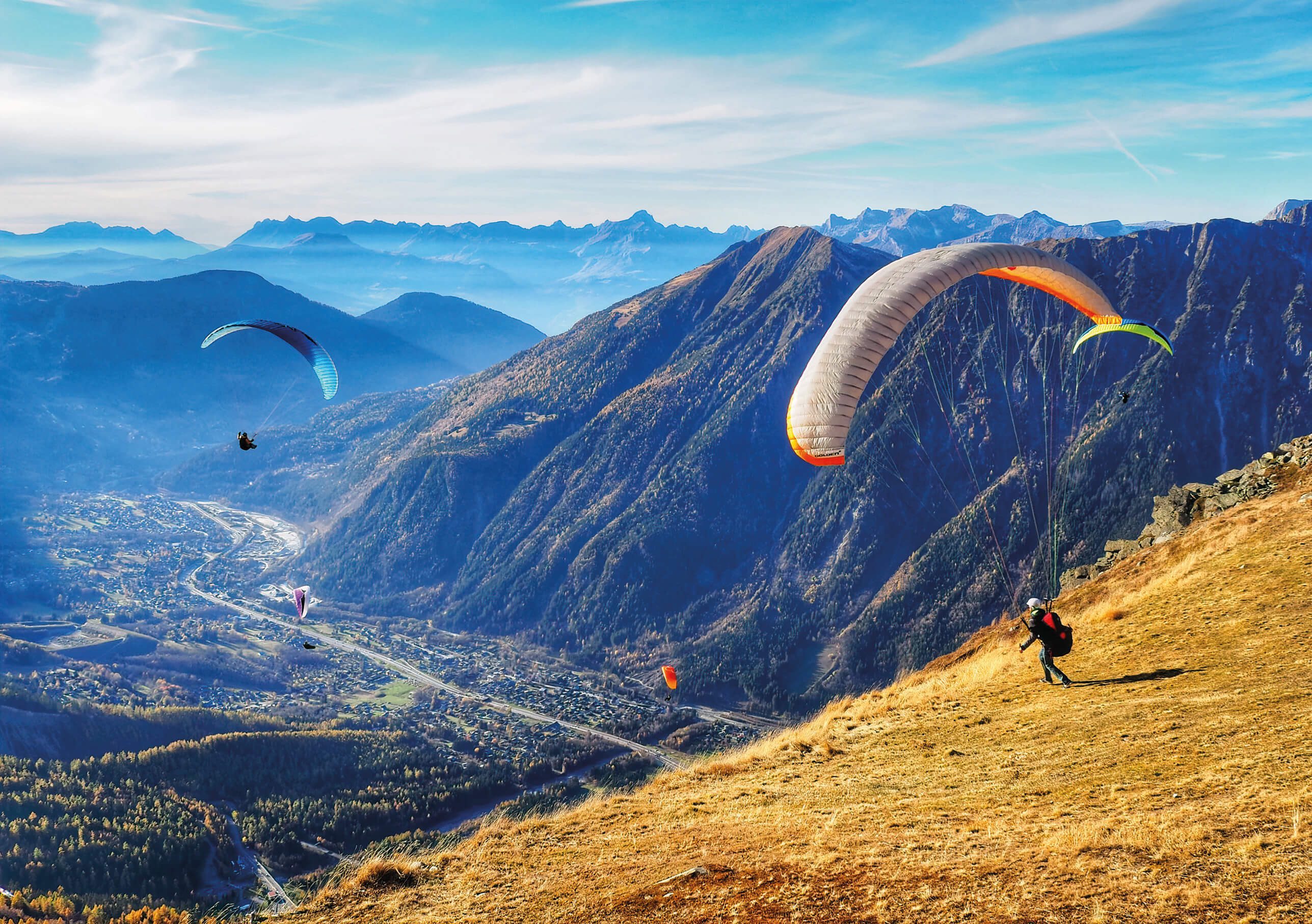
Post on topic: Paraglide: Fly like a Bird.
Don’t Go Too High
On October 22, 1797, the Frenchman André-Jacques Garnerin unfastened the basket of his hot air balloon at an altitude of 2,231 ft. No, it wasn’t a suicide attempt. This was a test of a prototype of the parachute — the first in the world, and Garnerin himself became the first parachutist in history.
The French daredevil was a big fan of balloons. Therefore, it is not surprising that he also thought about parachutes — aeronautics was an extremely dangerous occupation. The invention did not save Garnerin’s life, though — he died in a construction accident in 1823 when he was hit by a wooden beam while making another one of his balloons.

Many engineers, inventors, and athletes had a hand in improving the parachute. The main driver was the rapid development of aviation. But there is a singular individual who stood at the very center of the start of aviation and even gave his life for it. This is the German engineer Otto Lilienthal — the first glider in the world who overcame a distance of 328 ft on heavier-than-air aircraft. All his gliders were independently developed by him, including the first biplane.
Inventors considered a “bird’s sense for flight” a key condition for human flight — the ability to predict wind speed and direction. Developing this sense, according to Lilienthal, was possible only through practice. He had every right to make this assertion — he completed more than 2,000 flights!
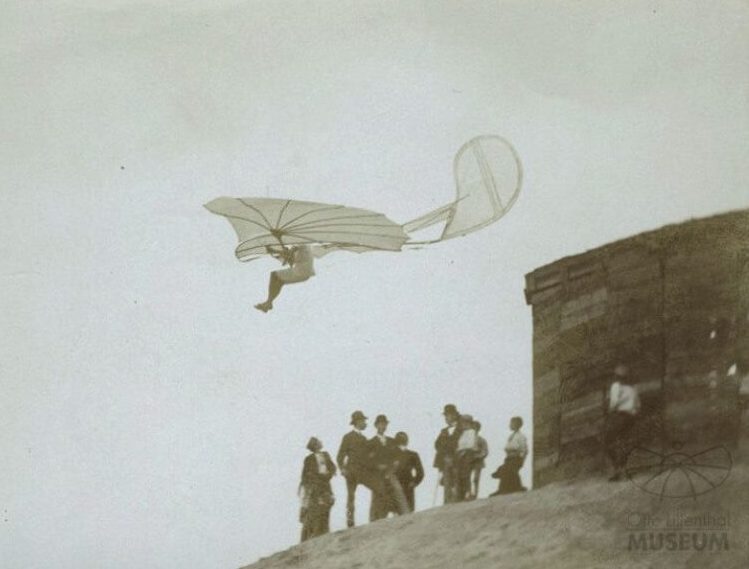

The brave aviation pioneer died due to a fracture in his spine when his glider fell. The news of his death reached even the reclusive aerodynamics theorist Nikolay Zhukovsky. In a speech dedicated to the scientist’s memory, Zhukovsky, personally acquainted with Lilienthal, foretold:
“The flights of this flying man were thought out theoretically, tested out in practice… The restless thirst for victory over nature will wake again in people, and Lilienthal’s experiments will begin again, and his way of flying will be developed and improved once more!”
Key Parameters
Between the flimsy designs of the German aviation pioneer and the gliders that can travel long distances without a motor, there is a huge but not fundamental difference. To compare such aircraft, aerodynamic quality is a key parameter. This is the ratio of lift to drag at a normal angle of attack.
The record holder for this parameter is the German-Italian glider Eta: a value of almost 70! For comparison, the most popular passenger aircraft, Boeing 737 and 747, boast values of 15 and 17, respectively, while the swift Concorde exhibits only 7 — with all its lift power, its design has a lot of drag.
Comparison of aerodynamic qualities
of various aircraft

The result of aerodynamic quality is a glide ratio — the ratio of the horizontal flight distance to the initial altitude. In modern gliders, it reaches 60:1.
Run before You Jump
In the 1930s, interest in gliding became widespread. This was driven by the military in every possible manner: for a glider is a future pilot, and to strengthen the Air Force, a reserve of flight personnel is absolutely necessary for all countries without exception. The paratroopers, when looking at the fixed-wing aircraft soaring in the bottomless sky, sorely envied the gliders: regular round parachutes only allowed you to move downward and drift with the wind, leaving the person under the canopy with few control options. In the language of numbers, the glide ratio for an airborne parachute is almost always less than one.
In the late 1940s, parachutes that allowed for horizontal steering by a distance approximately equal to the height of the ejection (glide ratio = 1) appeared. The shape of the “air tent” underwent radical change: instead of single-layer, hemispherical dome-shaped canopy, multilayer, rectangular “sacks” were used, puffing up under the pressure of the air stream. Now, the parachutist could, due to the tension of the suspension lines, change the angles of attack and the roll of the soft wing — meaning they could perform more complex maneuvers in the air.

Over time, the idea of a “soft” paragliding wing was embodied in parafoil — a two-layer sectional parachute, developed by American engineer Domina Jalbert in 1964.

Parafoil owes its existence to new synthetic fabrics that replaced silk and cotton percale. The most popular material for parafoils (and now paragliders) was and remains reinforced nylon — thin, lightweight, durable, and airtight.
Focusing on Load Reduction
Why does the material need to be airtight? When the parachute is opened, the canopy fabric experiences strong dynamic loads, and in order not to tear, it must either be durable or let air through a little. A third option is to reduce the load itself. For example, the most popular Soviet parachute D1–5U (commonly known as “oak”) was made of percale and forcibly opened immediately after separation from the aircraft, when the dynamic load was not ideal.
Zero Porosity Nylon ripstop fabric has virtually zero air permeability. This quality, protected by several patents, allows sectional canopies to immediately take on the desired shape, determined by the internal fabric ribs. With these concerns addressed, there was only one thing left to do — paraglide. This was done by American engineer David Theodore Barish on October 15, 1965. That day, on the slope of Hunter Mountain, not far from New York, Barish flew almost 230 ft on a paragliding parachute of his own design.
That doesn’t seem like a lot, but keep in mind: the aerodynamic quality of the device exceeded 4 units, and the separation from the ground occurred after a leisurely take-off without the aid of any mechanisms.
The inventor believed that his design could launch a new sport — slope soaring. Throughout the second half of the 1960s, David and his son, Craig, traveled to American ski resorts and demonstrated the products of their company, Barish Sailwing, while improving the design of the paragliders. Unfortunately, in America, their efforts were in vain.
European Boom
The beginning of paragliding as a mass sport is more closely associated with the small French town of Mieussy in the foothills of the Alps. In June 1978, three parachutists, Jean-Claude Bétemps, André Bohn, and Gérard Bosson, who had little opportunity to rent a plane for jumping off, came across an article about flying from mountainsides in the annual Parachute Manual.
Having examined their surroundings, they found a suitable spot — the slope of Pointe du Pertuiset. The first 328-ft flight was made by Bétemps on the “parafoil.” Bohn, who followed him, managed to fly to the football field in the valley, overcoming more than a kilometer (0.62 mi). This took place on June 28, 1978.
When David Barish visited Europe in the late 80s, paragliding had already become a mass sport with the corresponding records, championships, and infrastructure. Barish, who had long abandoned paragliding, was surprised by the sheer number of companies that produced equipment for such flights at the mountain resorts in Switzerland. In 1995, Barish became a guest of honor at the Coupe Icare paragliding competition in Saint-Hilaire, France. He couldn’t believe the number of paragliders at the starting line! The man who had come up with everything that makes up a modern paraglider — inflated closed sections, an aerodynamic profile, trimmers, airtight fabrics, valves, 26-ft slings, a large wing extension — witnessed a major boom in paragliding that has not ceased to this day.
How paragliding works
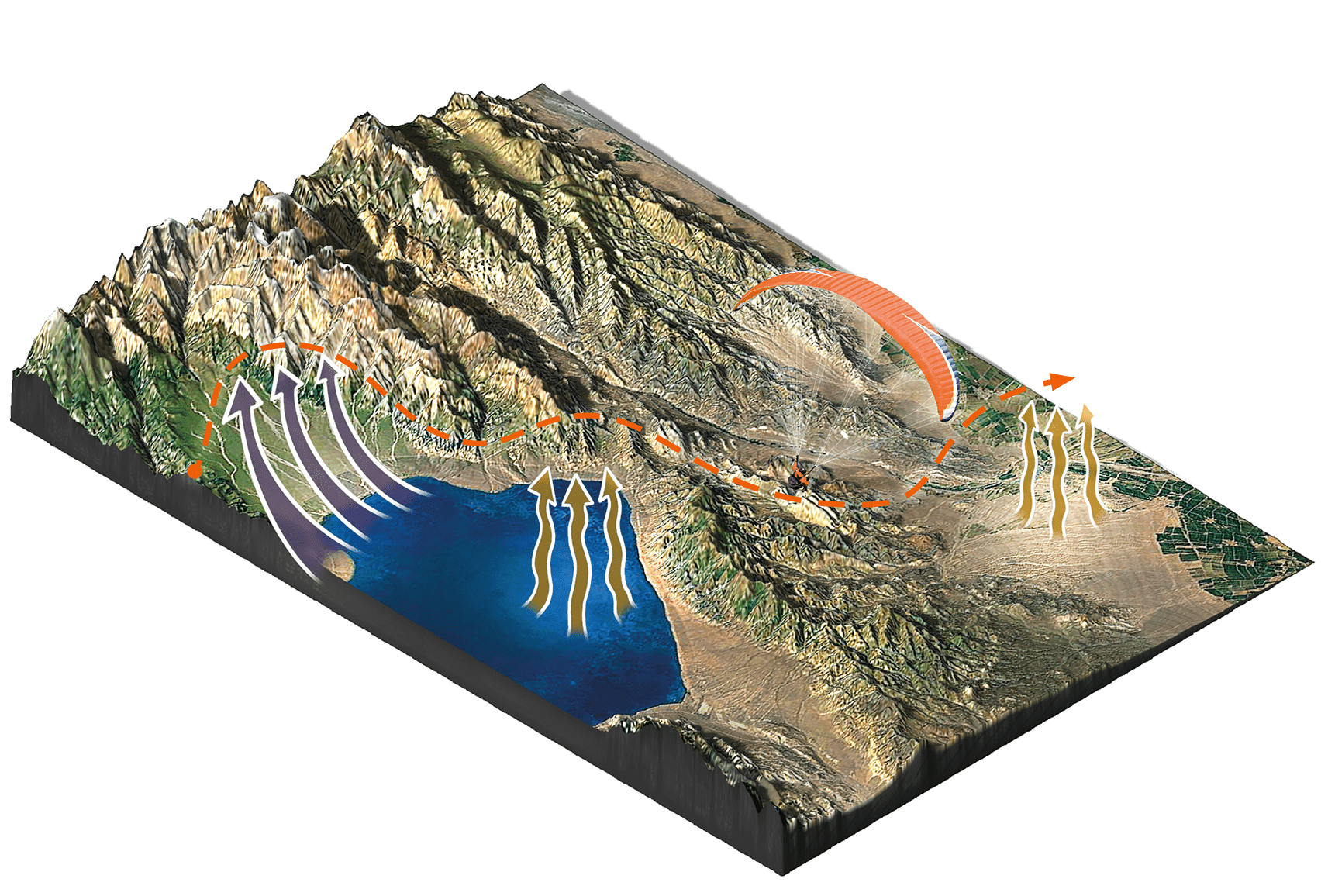
Ridge lift
Air mass (wind), moving up the mountain from the windward side, rises and creates an upward flow. The pilot’s task is to stay within this part of the slope.
Thermal lift
Warm air rises from the Earth’s surface up into the atmosphere. The task of the pilot is to find such a stream and stay within it. Similar tactics are used by many birds.
Paragliding People
Relatively cheap compared to gliders, paragliders fold into backpacks for easy transport on public transport. Launch requires minimal infrastructure – just a suitable slope and a few minutes to set up. Even without ideal wind, towing options exist. This accessibility fuels paragliding’s success.
The achievements of paragliders have been impressive. Having developed a “bird’s sense of flight,” they manage, using the ascending currents of warm air (in the jargon of paragliders — “thermalling”), to gain an altitude of more than… 5 mi! This was precisely the result achieved on July 23, 2016, by the French paraglider Antoine Girard, who flew over Broad Peak (the 12th “eight-thousander” in the world) in Karakorum, Pakistan. On October 13, 2016, three Brazilian paragliders Donizete Lemos, Rafael Saladini, and Samuel Nascimento crossed 1,850 ft in a straight line — another record.
Previous slide
Next slide
Paragliding Aerobatics
It’s unlikely that David Barish, gliding at a “kid’s” height above the hillsides, could guess what his followers would get up to. The first one to step on the slippery slope was the legendary Swiss paraglider Andy Hediger, a multiple winner and prize-winner of world championships in parachuting and air sports. In 1994, he amazed spectators and fellow paragliders with an Infinity Tumbling trick on a paraglider.
But paragliding aerobatics took shape as a full-fledged sports discipline through the efforts of Spanish paragliders — Horacio Llorens and the brothers Raul and Félix Rodriguez who founded the famous SAT (Safety Acro Team). Slides, spirals, loops, revolutions — paragliders are capable of all kinds of aerobatics! A maneuver invented by Raul Rodriguez, in which the pilot enters a spiral and brakes one side of the wing, is named after SAT and is the aerial analog of the fouetté in ballet.

Combining Experience and Sustainability
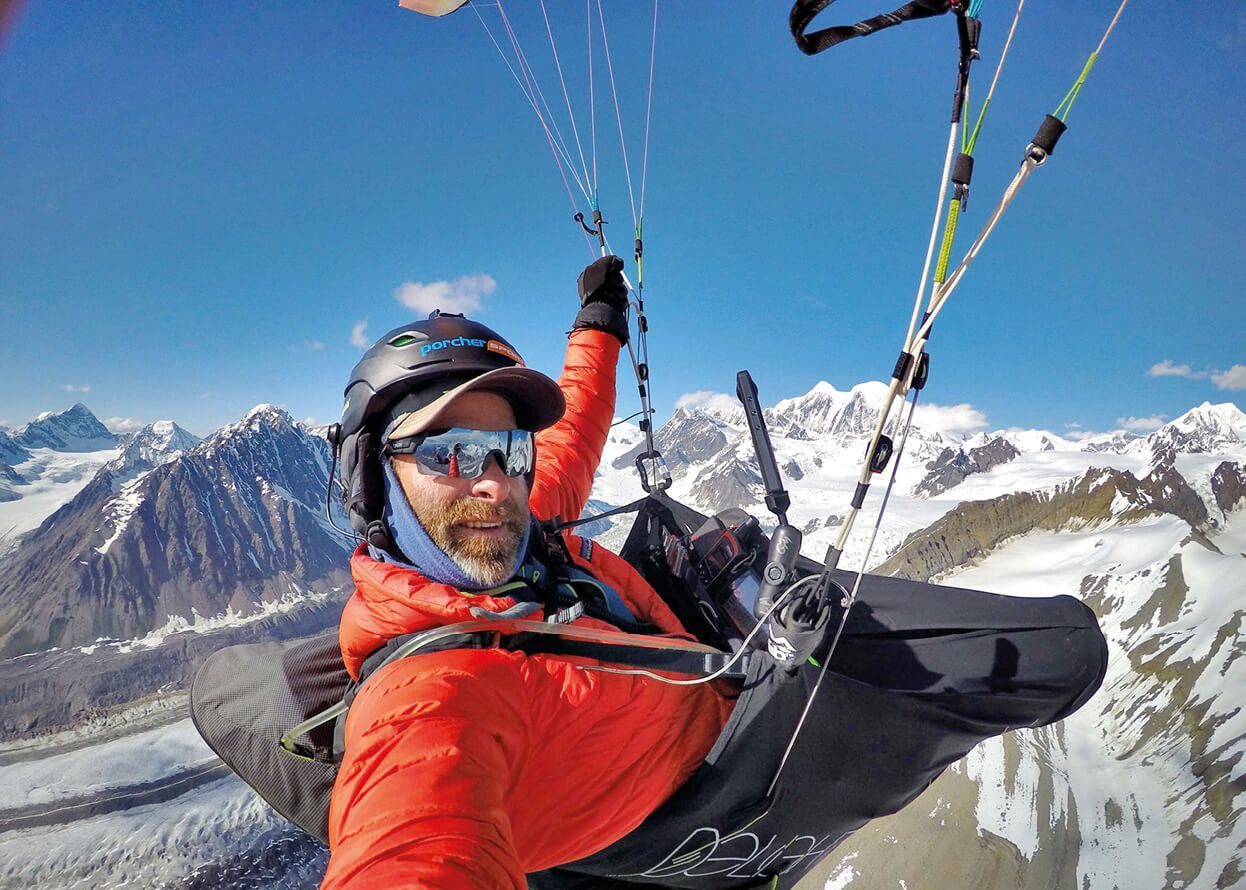
The paraglider has created a completely new type of tourism with a minimal negative impact on nature — vol-bivouac. In addition to the standard equipment, a person will take a tent, sleeping bag, and food supplies. They will then fly tens of miles from one of the slopes without any motors (and if “thermalling” is favorable, then hundreds) and settle down for the night on a suitable mountain site. A paragliding tourist can cover a significant distance in just a few days. In May–June 2017, American paragliders Gavin McClurg and Dave Turner undertook an extreme vol-bivouac with a length of over 435 mi over the Alaskan mountain range. But most experienced paragliders opt for mountain ranges much further south — the Karakorum and the Himalayas, overlooking the greatest mountain ranges from a bird’s eye view. Lilienthal would have been thrilled!!
Did you like the post? We invite you to read our other topics in Education category.
Follow us on Instagram.
<svg xmlns="http://www.w3.org/2000/svg" xmlns:xlink="http://www.w3.org/1999/xlink" id="Layer_1" x="0px" y="0px" viewBox="0 0 597.03 475.39" style="enable-background:new 0 0 597.03 475.39;" xml:space="preserve"><style type="text/css"> .st0{clip-path:url(#SVGID_00000021828697454809692600000004318893268413411000_);fill:#54A7B7;}</style><g> <defs> <rect id="SVGID_1_" x="63.22" y="2.39" width="470.59" height="470.65"></rect> </defs> <clipPath id="SVGID_00000125586198135712050590000014503595150480814249_"> <use xlink:href="#SVGID_1_" style="overflow:visible;"></use> </clipPath> <path style="clip-path:url(#SVGID_00000125586198135712050590000014503595150480814249_);fill:#54A7B7;" d="M352.92,237.74 c0-30.06-24.38-54.38-54.38-54.38c-30.06,0-54.38,24.32-54.38,54.38c0,30.01,24.32,54.38,54.38,54.38 C328.54,292.12,352.92,267.74,352.92,237.74 M440.15,237.74c0,78.06-63.55,141.62-141.62,141.62 c-78.12,0-141.62-63.55-141.62-141.62c0-78.12,63.5-141.62,141.62-141.62C376.6,96.12,440.15,159.61,440.15,237.74 M533.83,237.74 c0-129.78-105.58-235.3-235.3-235.3c-129.78,0-235.3,105.52-235.3,235.3s105.52,235.3,235.3,235.3 C428.26,473.03,533.83,367.51,533.83,237.74"></path></g></svg>