Post on topic: Parasites Manipulators.
Kicked out and Crucified
The setting: a rainforest. Starring: the carpenter ant, Camponotus rufipes, and the fungus, Ophiocordyceps camponoti-rufipedis. Some species of Cordyceps parasitize on caterpillars, flies, and other insects, but Ophiocordyceps camponoti-rufipedis is unique in that it can change the behavior of its victims. This fungus infects the tropical ant Camponotus rufipes: when infected, the social insect leaves the anthill, finds a leaf low off the ground, and picks a place on the vein on the underside of the leaf. The fungus has achieved its purpose and grows through its victim — soon there’s only the chitinous silhouette left on the bottom of the leaf. Then, the fruit body ripens and releases spores that infect other ants, and the cycle repeats.
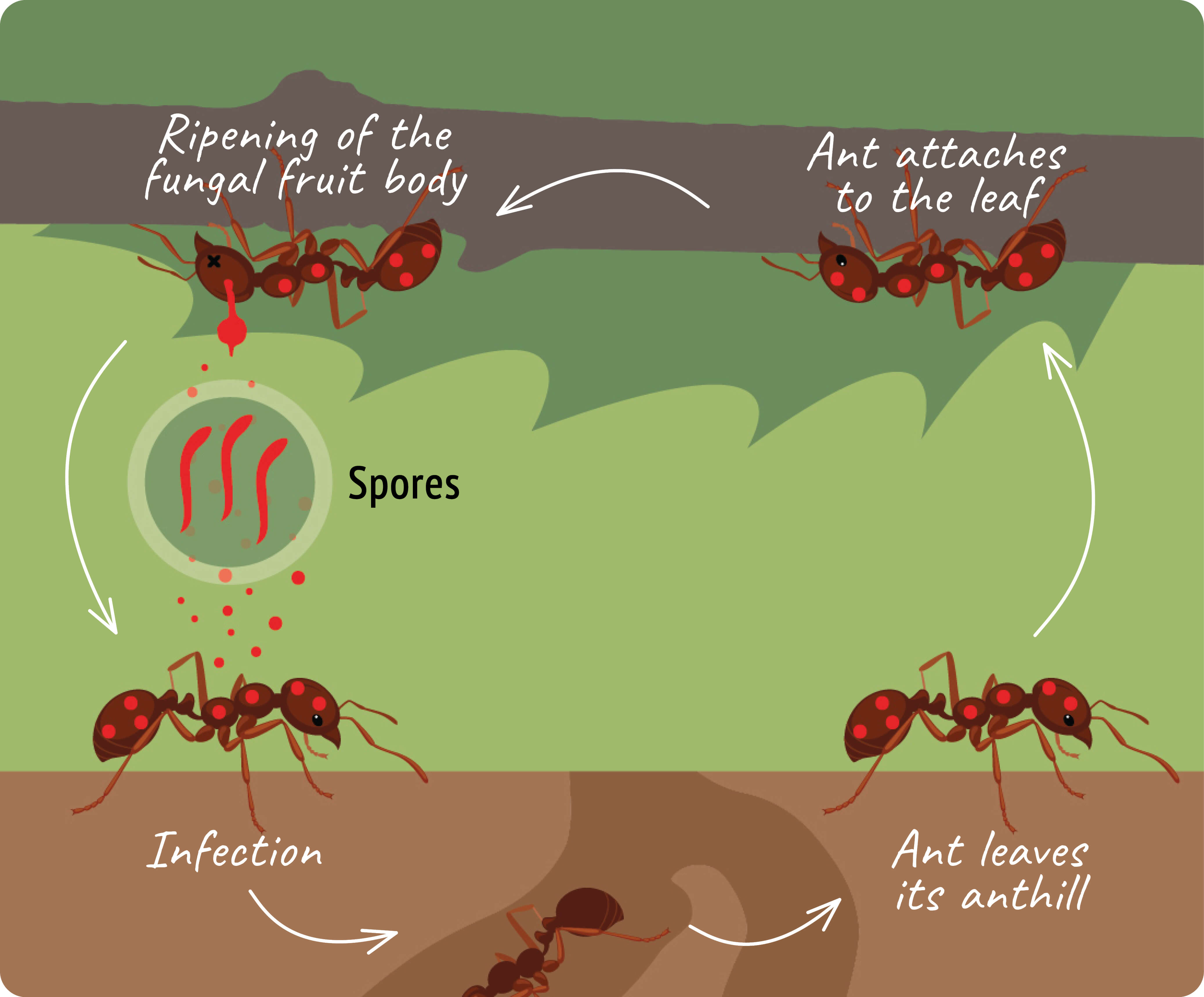
How the fungus controls the ant
If relatives of the zombifier fungus get by without complex manipulations, why does Ophiocordyceps camponoti-rufipedis need it? Because the inhabitants of the anthill are worried about order and sanitation: they take the dead out of the house and bury them outside. Scientists from the US and Brazil decided to find out what would happen if the bodies of infected ants ended up in an anthill. As expected, the corpses were promptly removed from inhabited anthills. But even when the carcass of an infected ant was placed inside an abandoned anthill, the fungus would not sprout. The zoologists concluded that the conditions inside might be unsuitable. So they began to monitor the movement of ants relative to anthills and leaves with germinated fungus.
It took them as many as 20 months of observations to notice a curious feature of the parasite fungus. Steered the victims to a relatively close location: most of the leaves with dead ants were located near the foraging paths leading to the anthill. It turns out that the fungus “aims” not to get inside the anthill, but to increase its chances of infecting new victims.
Discomfort or Manipulation?
The ergot fungus Ophiocordyceps camponoti-rufipedis exclusively uses ants as hosts. In some parasites, the life cycle is more complicated: eggs of one species get infected and host the parasite while it is in the larva state. However, the “guest” reaches sexual maturity in another host. That is exactly the lifestyle of the beef tapeworm from zoology textbooks, Taenia saginata. This tapeworm does not control the behavior of its hosts to multiply, but its relative, Ligula (Ligula intestinalis) has been caught red-handed manipulating its intermediate carrier.
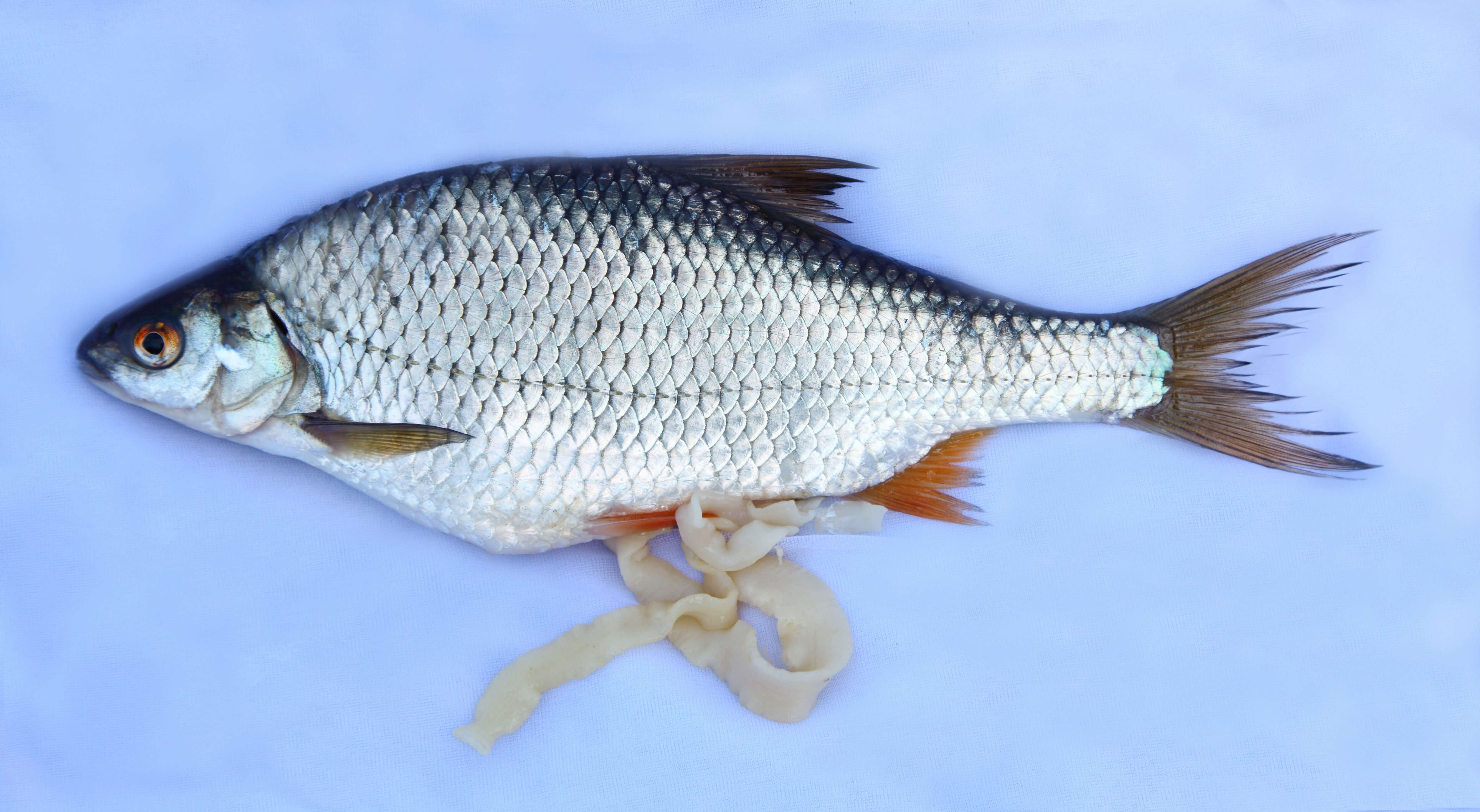
The life cycle of Ligula is in no way connected with either humans or cattle. It is even more complicated than that of the beef tapeworm. Once in the water, Ligula eggs turn into small floating larvae. They are swallowed by small crustaceans, and the larva loses cilia and the ability to swim. At the next stage, a fish consumes the crustaceans, and within 10 to 12 months, the microscopic larva becomes a worm that can reach up to 3 ft in length.
Such a parasite causes a lot of inconvenience to its host. The fish infected with Ligula begins to swim closer to the surface. This significantly increases their chances of being eaten by the final host, a seagull, or another bird of prey. Once inside the seagull, Ligula begins to produce lots of eggs, which get back into the water with bird’s feces, thus closing the cycle. The worm dies inside the bird without causing it any harm.
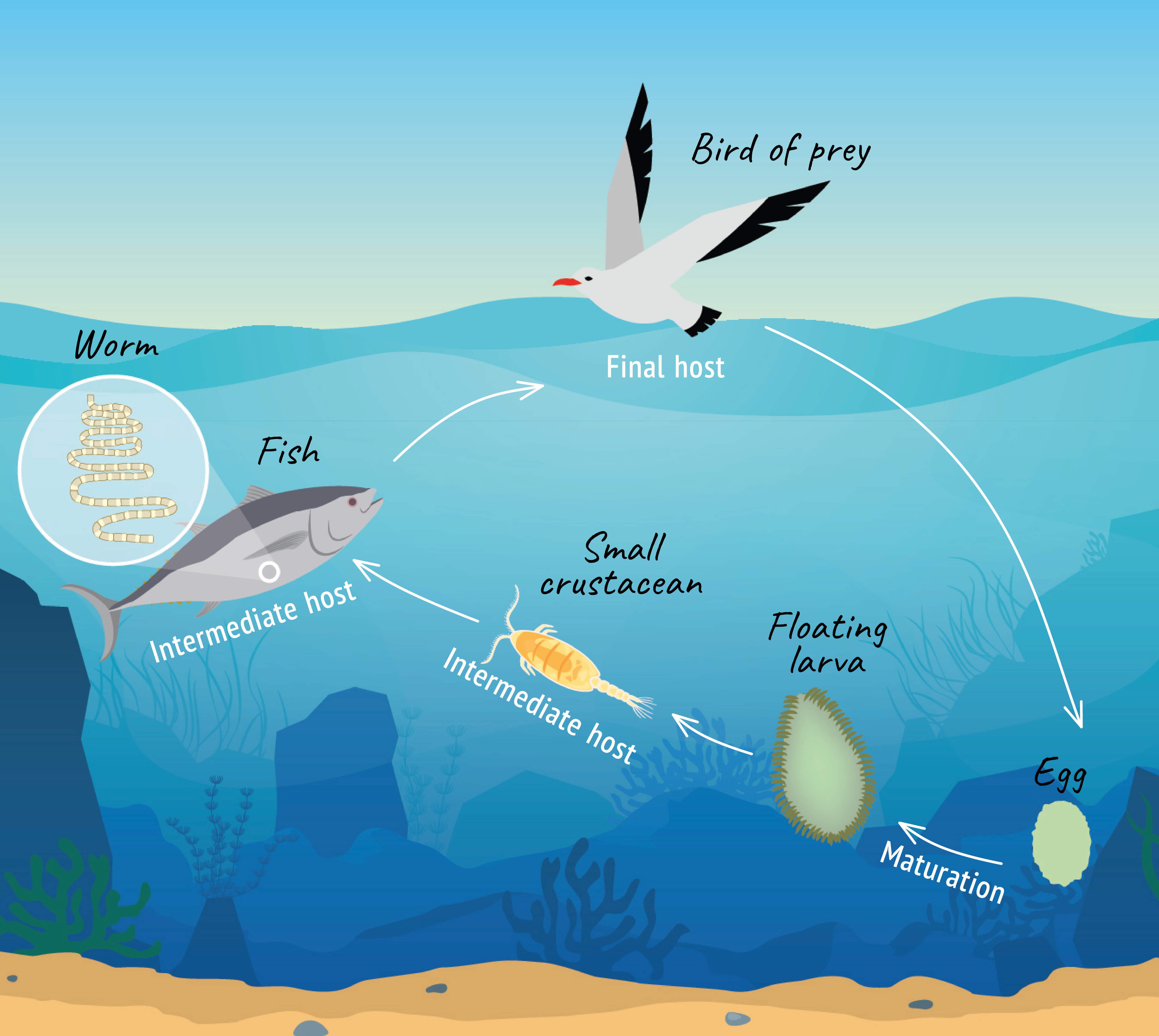
Life cycle of ordinary Ligula
What makes a fish stay near the surface of the water? Is it internal discomfort and loss of balance due to an overgrown parasite inside? Or does the worm “purposefully” affect its intermediate host? There is no consensus here. However, a recent study at the University of Bergen can be considered a weighty argument in favor of the second theory.
Researchers caught fish from different depths and evaluated them by the degree of infestation with Ligula: uninfected; infected, but the worm has not reached puberty; infected, and the worm is ready to “switch” hosts. It turned out that, although at early stages the parasite is comparable in size to mature individuals. The infection does not affect the depth at which the fish lives. So, the point is not the discomfort caused by the pressure the parasite exerts on the internal organs, but rather the intentional manipulation by the worm. What mechanisms the Ligula uses to control the behavior of its intermediate host is still a mystery.
If You Smell a Cat, Go Chase It
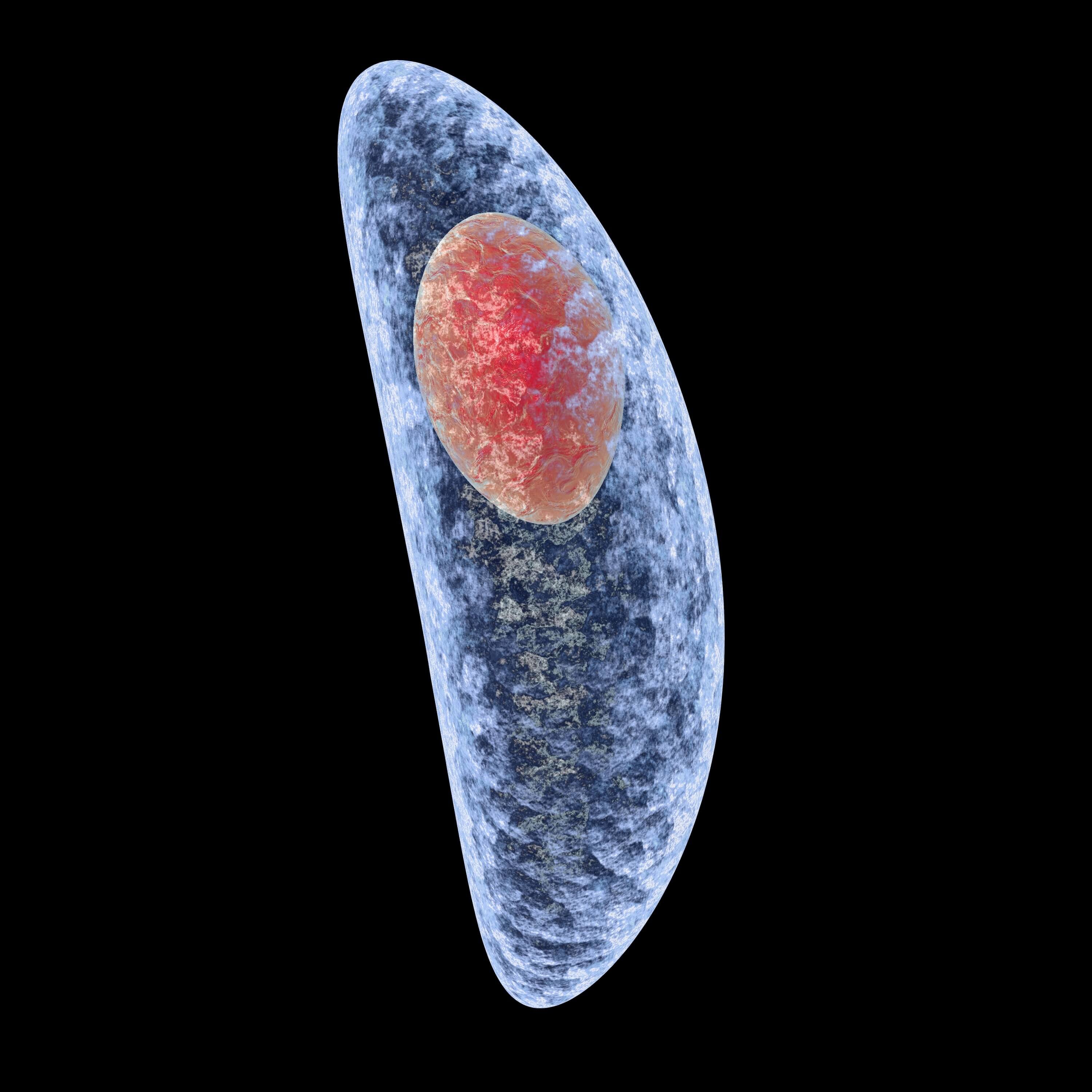
In fact, changing the behavior of the intermediate host to get to the final one is a fairly common strategy in parasites. Perhaps Toxoplasma may be the most well-studied such manipulator. Toxoplasma gondii is a single-celled Apicomplexan eukaryote, a close relative of the malaria parasite. The final host of Toxoplasma is always a feline, while the range of intermediate ones is unusually broad. They can be birds, rodents, or primates (including humans), and all of them become the subjects of manipulation.
It’s relatively easy to explain how a parasite manipulates rodents: typical feline food is mice and rats. Toxoplasma seeks to increase the chance of an infected rodent bumping into a cat and “forcing” the former to be attracted to the smell of a cat’s urine. It’s a bit more complicated with primates. Big cats, such as leopards, hunt primates. Therefore, monkeys infected with Toxoplasma also become bolder and go after feline smell, disregarding their own safety.
In the modern world, it is difficult to imagine a cat eating a human being. However, vulnerability to Toxoplasma was most likely inherited from our primate ancestors. Most healthy people do not experience any symptoms…except for one — behavioral change. The tendency to take risks, a passion for bloody meat, and an immense love for cats and their smell — toxoplasmosis may be the reason for such symptoms. According to various estimates, anywhere from 10% to 90% of the world’s population is infected. Some scientists believe that Toxoplasmosis has determined the culture of whole nations. It is associated with the cult of the cat goddess Bastet in ancient Egypt and the French love for undercooked steaks.

Life cycle of Toxoplasma
Parasites | How to Ride a Cockroach
The art of manipulation has been mastered not only by parasites that target as many victims as possible but also by parasitoids that live most of their life separately. In the African savannas, there lives a pair of codependent insects. The emerald cockroach wasp (Ampulex compressa) and the cockroach. The species of cockroach in the pair does not matter, which is what has helped it spread throughout South Asia and even reach some of the Pacific Ocean islands. For example, Hawaii — the wasp knows what it wants. In all these regions, cockroaches are endemic.

Obviously, the wasp dominates in this relationship. It looks unusual: the wings are reduced, the elongated body is emerald green. It lives in small holes in the ground. Why does it need a cockroach? Because it’s a means of breeding. Although the wasp itself is not a parasite, scientists attribute the cruel treatment of cockroaches to a cohort of parasitoids.
The wasp ambushes its victim and slowly sneaks up on it. Then, with a clear and sharp movement, bites at its neck; the second bite hits the brain area. After such an attack, the cockroach loses its will, and the wasp takes it by the antenna, leading it around. The victim follows it into a hole where the wasp lays eggs on it. Hatching larvae then eat the cockroach, which is still alive and not even trying to escape. The larvae feed, turn into beautiful adult wasps, and start looking for a partner…and then for a cockroach of their own.
The emerald cockroach wasp and the cockroach
What is happening between the emerald cockroach wasp and the cockroach is pure chemistry. If the first bite is intended to make the cockroach less resilient, then the second injects a cocktail of complex compounds into the brain area of the victim. One of the main substances in this cocktail, it seems, is an antagonist of the neurotransmitter octopamine. Scientists from Ben-Gurion University of the Negev (Israel) tried to inject the zombified cockroaches with various antidotes and watched what would happen. The ability to freely move was restored in response to the injection of a substance that unblocked octopamine receptors. The introduction of octopamine receptor antagonists turned normal cockroaches into zombies, as though they had been attacked by an actual wasp.
                                                <img width="800" height="659" src="https://oyla.us/wp-content/uploads/2023/07/scheme-4-3.jpg" alt="Lyfe cycle of natural born manipulators" />
        <h4>Life cycle of an emerald cockroach wasp
Parasites | Avoiding Shackles
For some parasites, a human being is a dead-end host. Therefore, they try to get out as soon as possible and move to a new stage of the life cycle, often using their manipulative “skills.” There was one notable case of a 14year-old American teenager who suddenly began to show symptoms of schizophrenia, depression, and obsessive-compulsive disorder. Two years of treatment with psychopharmacological drugs were of no use. It soon became clear that the teenager was infected with the bacterium Bartonella henselae, which he most likely contracted from a scratch from a domestic cat. Long-term treatment with antibiotics, antifungal, and anti-inflammatory drugs cured the bacterial infection, and his mental state also returned to normal.
It’s pretty easy to fend off zombie parasites if you’re human; just observe basic sanitary and hygienic rules. For example, wash your hands before eating, rinse produce before eating it, and treat meat with heat thoroughly. Also, be careful with pets. After coming in contact with them, wash your hands, and promptly handle scratches and bites with an antiseptic. Following these rules, you will protect yourself from manipulating organisms and from many other dangers, as well.
Post on topic: Pi Number
Did you like the post? We invite you to read our other topics in Education category.
Follow us on Instagram.
<svg xmlns="http://www.w3.org/2000/svg" xmlns:xlink="http://www.w3.org/1999/xlink" id="Layer_1" x="0px" y="0px" viewBox="0 0 597.03 475.39" style="enable-background:new 0 0 597.03 475.39;" xml:space="preserve"><style type="text/css"> .st0{clip-path:url(#SVGID_00000021828697454809692600000004318893268413411000_);fill:#54A7B7;}</style><g> <defs> <rect id="SVGID_1_" x="63.22" y="2.39" width="470.59" height="470.65"></rect> </defs> <clipPath id="SVGID_00000125586198135712050590000014503595150480814249_"> <use xlink:href="#SVGID_1_" style="overflow:visible;"></use> </clipPath> <path style="clip-path:url(#SVGID_00000125586198135712050590000014503595150480814249_);fill:#54A7B7;" d="M352.92,237.74 c0-30.06-24.38-54.38-54.38-54.38c-30.06,0-54.38,24.32-54.38,54.38c0,30.01,24.32,54.38,54.38,54.38 C328.54,292.12,352.92,267.74,352.92,237.74 M440.15,237.74c0,78.06-63.55,141.62-141.62,141.62 c-78.12,0-141.62-63.55-141.62-141.62c0-78.12,63.5-141.62,141.62-141.62C376.6,96.12,440.15,159.61,440.15,237.74 M533.83,237.74 c0-129.78-105.58-235.3-235.3-235.3c-129.78,0-235.3,105.52-235.3,235.3s105.52,235.3,235.3,235.3 C428.26,473.03,533.83,367.51,533.83,237.74"></path></g></svg>