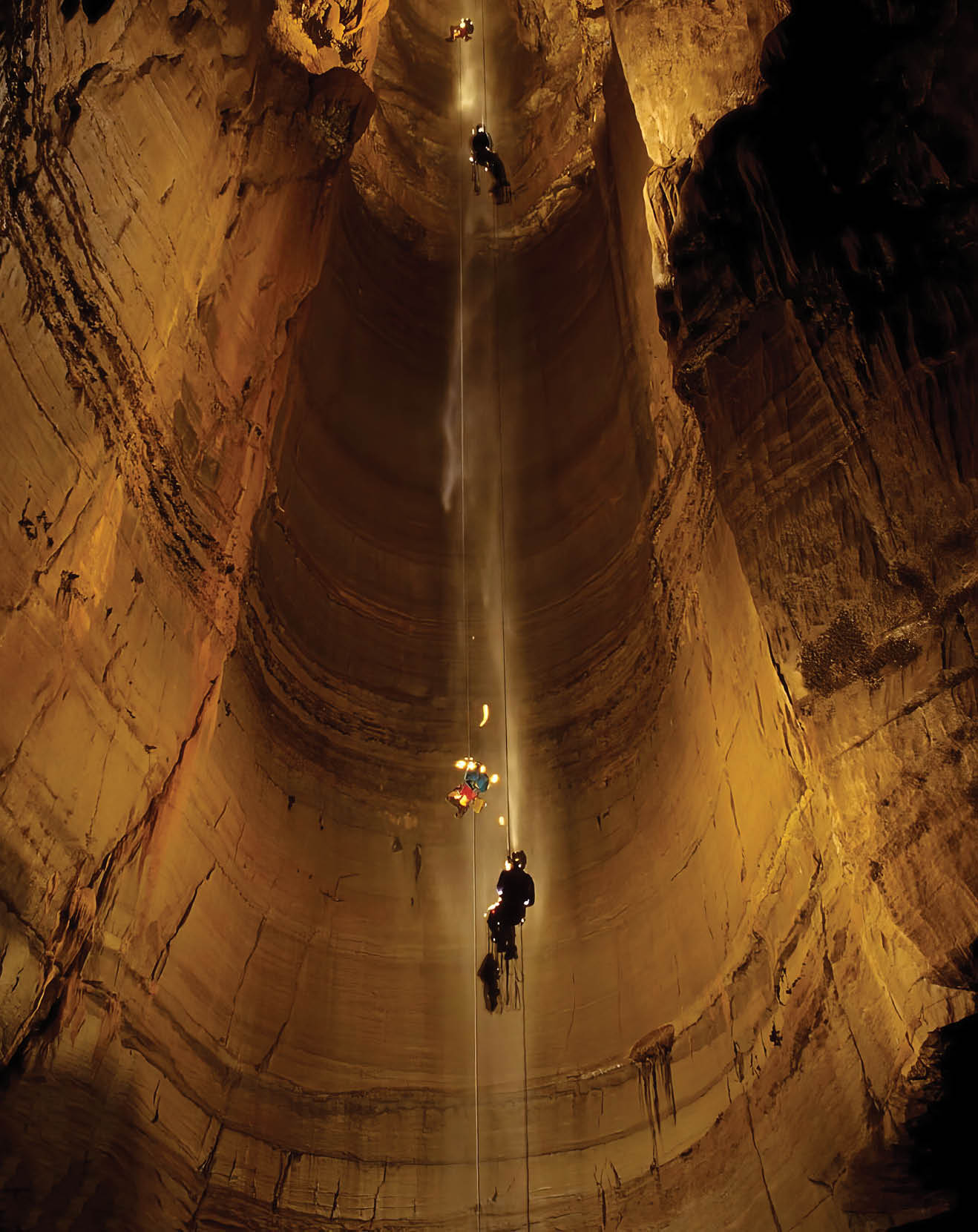
What’s a cave — is it really such a complicated question? Speleologists, the scientists who study them, aren’t always in agreement on this question. Some consider any cavity in the Earth’s crust that was formed in a natural way to be a cave. Then would a mole hole be considered a cave? Other speleologists specify that a cave must be large enough for a person to fit inside without the Sun illuminating all of its area. Then what about caves inside glaciers, where the Sun shines even through thick walls? To avoid confusion, speleologists identify caves by their origin.
Karst Cave Formation

The most common caves are karst, which are formed from the dissolution of rocks. It happens like this: rainwater absorbs carbon dioxide from the atmosphere and penetrates the soil. On the way to the rocks, it interacts with organisms in the soil and accumulates even more carbon dioxide, and its pH becomes more acidic. Easily soluble rocks, such as limestone, chalk, gypsum, and salts, are soaked with this water, and the resulting alkali dissolves silica — the main mineral that makes up the Earth’s crust.
The cavity inside the rock grows larger. The remaining water drips from the ceiling of the formed cave, where there is a lot of calcium bicarbonate after the rocks’ dissolution. Salts accumulate on the cave floor and arch, forming bizarre pillars and icicles called stalactites (above) and stalagmites (below).
Caves can also appear as a result of erosion, tectonic plate movement, or volcanic eruptions. If a glacier melts from below, water flows out through ice cracks and leaves a network of tunnels and cavities, which is called a glacial cave.
But enough with the theory! Let’s go on a speleological expedition right within the pages of our magazine.
So’n Đoòng Cave (Vietnam)
So’n Đoòng is a good example of how little our planet has been studied. This is the world’s largest natural cave, but no one in the scientific community had heard of it until 2009! A group of British speleologists was led to So’n Đoòng by a local farmer who had stumbled upon the entrance to a giant cave 18 years prior. In one of its sections, its arch height and passage width is about 650 ft and 325 ft, respectively. This space can accommodate a couple of 40-story skyscrapers or even a Boeing-747 flight. The total cave length is about 5.5 mi.


So’n Đoòng is a karst cave, approximately 2–5 million years old. Large stalagmites have formed inside it, some even getting their own names. Hand of Dog, for example, looks just like an outstretched dog paw, but one that is 230 ft tall.
Veryovkina Cave (Abkhazia, Georgia)

Another freshly-minted record holder. Veryovkina, a karst cave, was discovered by Soviet speleologists in 1968 but received the title of the world’s deepest (at 7,230 ft) only three years ago. During the next research expedition (there have been several dozen over the years) in 2018, scientists measured the depth of the last Nemo station terminal siphon lake, which added an additional 26 ft to this record depth. Research is still ongoing.
How is it that the Veryovkina Cave length (8.3 mi) and depth are greater than those of So’n Đoòng, but the latter is still considered the world’s largest? That’s because, compared to the colossal So’n Đoòng, there are many narrow tunnels and sections. One of its sections is so narrow that climbing equipment must be put on while lying down.
Mammoth Cave (Kentucky, US)
What about the world’s longest cave? It exists — all 400 mi of it! In fact, Mammoth Cave is still being explored, and speleologists say that there is no end in sight. In any case, it’s enough to attract more than two million visitors a year to Mammoth Cave National Park. Tourists also flock there due to the fact that several mummified remains of indigenous people groups were found there in the 19th century, the age of which scientists estimate to be 4,000 years. Mammoths, though, never set foot there. The cave got its name due to its gigantic size.

The Mammoth Cave is also karst, but a waterproof layer of rock lies above the arch in many of its sections, so it is dry inside, and stalactites and stalagmites are few and far between.
Sac Actun (Mexico)
Once again, this record was set only two years ago: in January 2018, the Great Maya Aquifer Project discovered that Sac Actun and Dos Ojos are interconnected and form one large underwater cave system. It’s a truly huge one: 215-mi long, second only to Mammoth Cave. Underwater, Sac Actun has no equal. Its average cave depth is about 65 ft.

Despite the fact that most of the cave system tunnels are flooded, the cave itself is a goldmine of archaeological artifacts: remains of extinct flora and fauna, Mayan ceramics, and human skeletons have been found. A millennia ago, Sac Actun was actually above the water surface.
Previous slide
Next slide
Eisriesenwelt (Austria)
Glacial and ice caves are easily confused. For example, Eisriesenwelt is unmistakably an ice cave: its walls are covered with a thick layer of ice, but an ordinary karst cave is hidden under it. The first limestone cracks formed about 100 million years ago, and then the water did its job. The oldest layers of ice in the cave are only 1,000 years old.

Eisriesenwelt’s labyrinths extend for more than 25 mi, so speleologists recognize it as the world’s largest ice cave. The ice here is formed due to temperature differences and drafts: water leaking from the warm sections of the cave meets a cold stream of air and freezes into bizarre ice sculptures. Unlike glacial caves, Eisriesenwelt is open to tourists in the summer (who want to avoid avalanches in the winter), but its ice does not melt all year round.
Kazumura Cave (Hawaii, US)
The Hawaiian cave of Kazumura formed only four to six centuries ago during the prolonged eruption of the Kīlauea volcano. Although the island has a hot climate, the temperature is cold for Hawaiian lava since the eruption occurred at about 1800 °F. A frozen crust formed around the lava flow, under which a river of molten rock flowed. Soon it cooled down, decreasing in size and forming a cavity. Scientists call this phenomenon a lava tube.
Several such tubes formed during the eruption, but Kazumura is the longest and deepest among them and in the world. Many different elements color its arches, from white gypsum to green olivine. There are at least 101 entrances to Kazumura known to researchers.
Skaftafell (Iceland)
Tourists call the caves inside Vatnajökull National Park’s glaciers “sapphire” — the light piercing through the ice walls paints them a rich blue. Over millennia, the ice compressed under its own weight and pushed out the air bubbles, thus forming large opaque crystals. Algae can also end up in it, enhancing the cave’s blue tint. There is also evidence of volcanic eruptions in the cave that have left grey traces on the ice, like zebra stripes.
Previous slide
Next slide
The caves here are short-lived: they form every winter when the glacial rivers recede from the cold and an empty channel remains. Interestingly, the caves are formed in a new place every year. Employees of the national park simply choose the most spectacular one to show off to tourists. The largest can usually accommodate 100 people.
Marble Caves (Chile)

The majestic blue arches of these caves were eroded by waves: tunnels were carved by the waters of the General Carrera Lake over more than 6,000 years. The cliffs are made of marble, so the walls are smooth and exhibit a swirling pattern. The appearance of the cave depends on the time of year, the lake water level, and the local glaciers’ condition. In the summer, when the ice melts, the water in the lake rises and acquires a deep blue hue that is reflected on the cave walls. In its purest form, this marble is a grey color.
The Marble Caves are divided into three sections: the Cave, the “Chapel,” and the “Cathedral.” How else would you name such majestic stone chambers with marble arches?
<svg xmlns="http://www.w3.org/2000/svg" xmlns:xlink="http://www.w3.org/1999/xlink" id="Layer_1" x="0px" y="0px" viewBox="0 0 597.03 475.39" style="enable-background:new 0 0 597.03 475.39;" xml:space="preserve"><style type="text/css"> .st0{clip-path:url(#SVGID_00000021828697454809692600000004318893268413411000_);fill:#54A7B7;}</style><g> <defs> <rect id="SVGID_1_" x="63.22" y="2.39" width="470.59" height="470.65"></rect> </defs> <clipPath id="SVGID_00000125586198135712050590000014503595150480814249_"> <use xlink:href="#SVGID_1_" style="overflow:visible;"></use> </clipPath> <path style="clip-path:url(#SVGID_00000125586198135712050590000014503595150480814249_);fill:#54A7B7;" d="M352.92,237.74 c0-30.06-24.38-54.38-54.38-54.38c-30.06,0-54.38,24.32-54.38,54.38c0,30.01,24.32,54.38,54.38,54.38 C328.54,292.12,352.92,267.74,352.92,237.74 M440.15,237.74c0,78.06-63.55,141.62-141.62,141.62 c-78.12,0-141.62-63.55-141.62-141.62c0-78.12,63.5-141.62,141.62-141.62C376.6,96.12,440.15,159.61,440.15,237.74 M533.83,237.74 c0-129.78-105.58-235.3-235.3-235.3c-129.78,0-235.3,105.52-235.3,235.3s105.52,235.3,235.3,235.3 C428.26,473.03,533.83,367.51,533.83,237.74"></path></g></svg>