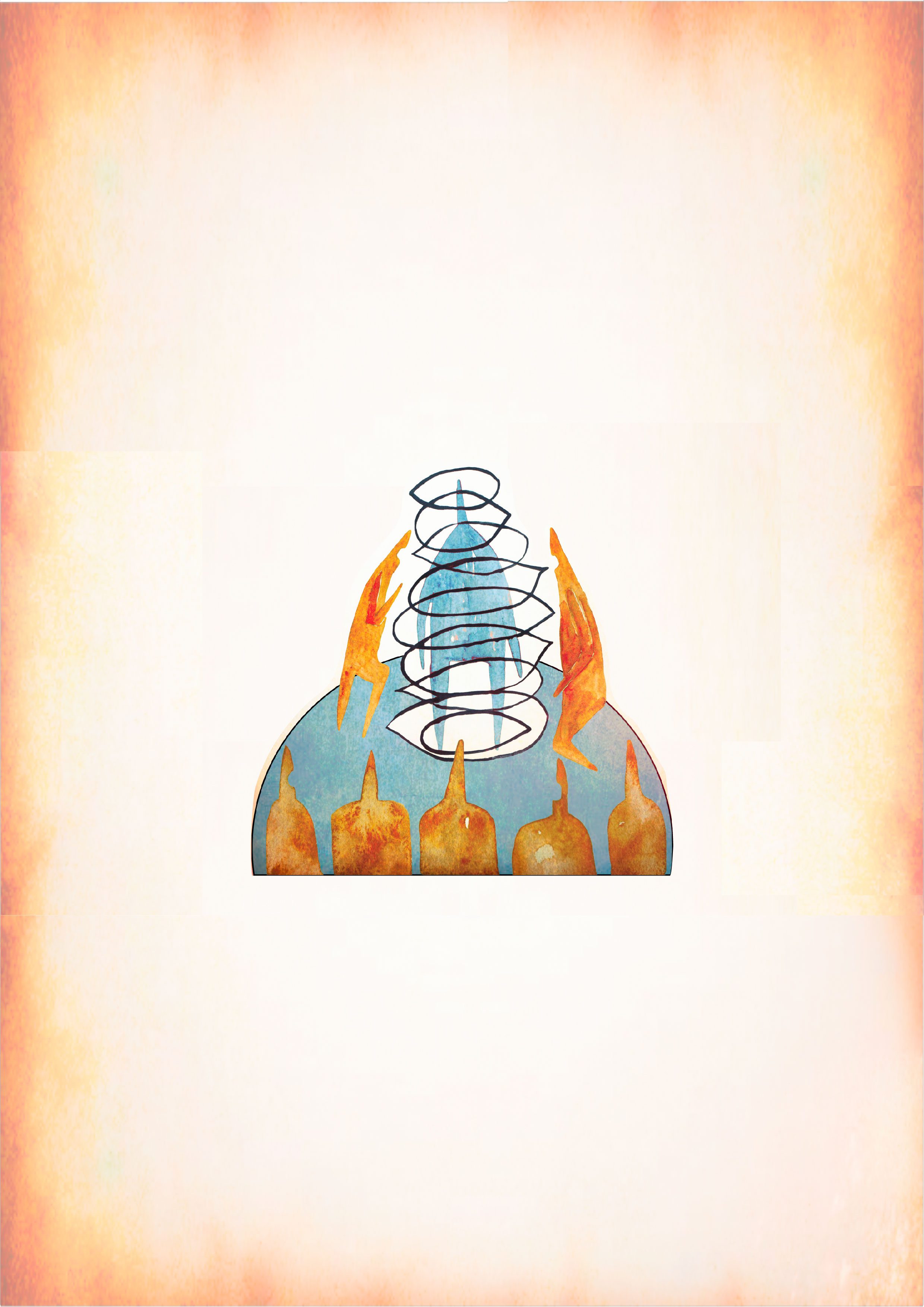
Post on topic: Majority Influence.
Legendary Foolishness
Till Eulenspiegel is the protagonist of many medieval Dutch and German legends, a vagrant and trickster. In one such tale, Till presents himself as a painter and, for a substantial reward, says that he will depict a Count surrounded by his fellow noblemen. The Count promises to execute the hero if he in any way distorts reality, while the noblemen threaten to kill him if he doesn’t make them look good.
Of course, the jolly Eulenspiegel isn’t fond of either option. Instead, he decides to cheat — he spends all the time he is supposed to be working by going to feasts and parties, enjoying the Count’s luxurious castle. On the appointed day, Till gathers all the tale’s heroes together to show them his creation. He points at a blank wall and declares that it contains a magical painting that can only be seen by legitimate members of the noble bloodline.
The Count’s Jester and the Vanishing Trick
Everyone pretends as though they can see the painting perfectly well, and they begin to discuss their portraits. In reality, however, the Count and his company only see a whitewashed wall and are very upset about it. Only the Count’s jester, habitually regarded as a fool by society, frankly admits that he sees no painting at all. Still, Eulenspiegel manages to disappear together with the money he’d been paid by the Count.
                                    <figure>
                                    <img width="800" height="744" src="https://oyla.us/wp-content/uploads/2023/07/image-4.jpg" alt="Majority. Pluralistic ignorance" />                                         <figcaption>Fairytale “The Emperor’s New Clothes”</figcaption>
                                    </figure>
    <p>A similar storyline is at the center of a fairytale by the Danish author <a href="https://en.wikipedia.org/wiki/Hans_Christian_Andersen"><b><u>Hans Christian Andersen</u></b></a>, “<i>The Emperor’s New Clothes</i>.” In it, a monarch walks around naked, but everyone around him pretends to admire his new outfit, which apparently is invisible only to fools. The lie is uncovered by a child, who shouts, “But the Emperor doesn’t have anything on at all!” At last, the crowd picks up on the child’s words, while the now-exposed Emperor continues with his procession.</p>
                                    <figure>
                                    <img width="800" height="590" src="https://oyla.us/wp-content/uploads/2023/07/image-10-1-e1689234237915.png" alt="Majority | Herd Instinct" />                                            <figcaption>Keeping silent due to their fear of being mocked</figcaption>
                                    </figure>
    <p>Both stories illustrate a common occurrence: no one actually believes the lies of impostors, but they keep silent due to their fear of being mocked. This leads to a paradoxical situation: everyone is confused about what’s going on but at the same time supports the shared delusion. This phenomenon is called <b>pluralistic</b> <b>ignorance</b>.</p>
        <h2>Majority Influence | Be Like Everybody Else
The desire to align with the majority was handed down to us by our ancestors. In the past, it wasn’t easy to survive on your own. Therefore, you had to find food and protect yourself against bad weather, your enemies, and wild animals together with your kinfolk. To this day, in educational institutions, interest groups, or the workplace, it is common to follow unspoken rules: keep close to the group, maintain team spirit, and try not to get into fights. Of course, following these rules is justified, since starting conflicts and sabotaging your work won’t do any good. Sometimes, though, we choose the wrong course of action just because everyone around us is doing it.

Solomon Asch’s Conformity Experiments
In the 1950s, psychologist Solomon Asch conducted a series of experiments on a group of eight students. They were introduced to each other as randomly-selected volunteers, but, in reality, seven of them were Asch’s research assistants. Everyone received two cards. One card had a single line; the other card had three lines, one of which was the same length as the line on the first card while the remaining two lines were considerably longer or shorter. The participants were asked to say aloud which of the lines matched.
They were seated in such a way that members of the “fake” group responded first, followed by the real subjects. It turned out that, if the correct answer was first given, then the real participant also went with the right option. When, however, all of Asch’s assistants, one after the other, confidently gave the wrong answer, the participants conformed to their choices. In a series of 12 experiments, 75 % of research subjects changed their answer to the wrong option after hearing the responses of others. In other versions of the experiment, Asch found that the more members of the group gave the wrong answer, the more frequently the “naïve” participants went along with it.
Majority | Implied Consent

A person needs to follow the crowd. Since ancient times, isolation and banishment from communities of our fellow tribespeople have been used as punishment for serious transgressions.
You may recall heroes of movies and books who had to overcome loneliness or even bullying from members of their groups who didn’t accept them. It isn’t surprising then that we often misinterpret the position of the majority — just like in the stories about the naked Emperor or the trickster Eulenspiegel, in which everyone in the crowd incorrectly “read” each other’s thoughts.
German political scientist Elisabeth Noelle-Neumann proposed the spiral of silence theory to explain why certain groups choose to remain silent while others actively declare their opinions. People who are confident that their stance is common are more likely to voice it in public. Those who see their beliefs as less popular will take a more moderate position in their public utterances — or they won’t say anything at all. According to Noelle-Neumann’s theory, the silent people are governed by a fear of punishment or isolation. That’s how we get societal beliefs that don’t account for the views of many people. Politicians, journalists, and opinion leaders can broadcast their ideas to large audiences, making everyone believe that they’re right.

The Silent Majority and Perceptions of Climate Change
At times, people who prefer to stay silent are the majority, which distorts our understanding of the real state of affairs. Psychologists Nathaniel Geiger and Janet Swim studied how students participate in discussions about climate change. In their studies, they found that those who were concerned about climate change were influenced by their perceptions of dominant opinions. If someone in the group stated that they denied the problem altogether, then even those students who were confident in their beliefs chose to stay silent.

Afterward, the researchers asked students why they stayed silent if they knew they were right. The students responded that they perceived their opinions as unpopular, so they didn’t engage with the discussion. However, based on calculations, those concerned with climate change constituted the majority.
With the advent of the Internet, smartphones, and social media, it has become easy to promote any belief and create the appearance of support for it. On the one hand, the Internet has helped many people to voice their opinions thanks to anonymity and various communities of interest, where you can always find like-minded people. On the other hand, the fear of revenge and isolation hasn’t gone anywhere. Now, we are faced with new phenomena — trolls and haters who can make any opinion appear insignificant, as well as actual digital harassment — cyberbullying.

The Price of Indifference
Sometimes, pluralistic ignorance can lead to horrible consequences. In 1964 in New York City, a criminal attacked a woman named Kitty Genovese. No fewer than ten people heard cries for help and even witnessed the crime, but none of them interfered. An ambulance was called after the offender had escaped, and the woman couldn’t be saved. This event triggered studies of “the bystander effect” — a psychological phenomenon in which people witness an emergency but don’t help the victims. People can unconsciously shift responsibility onto others, believing that someone else will help. A single witness often acts more decisively and is more likely to assist a victim.

In 2019, a similar tragedy took place in New York. A 16-year-old teenager, Khaseen Morris, was stabbed during a fight with a classmate. The attack was witnessed by around 50 people, but nobody helped out the teen, though they continued to film the event for social media. Khaseen was taken to the hospital too late, and the doctors couldn’t save him. The indecision of witnesses in the crowd can be attributed to pluralistic ignorance — the bystanders were worried that others would perceive their intervention as inappropriate.
That’s what leads to situations in which no one in a crowd does anything explicitly wrong, but together they let a tragedy unfold in front of their eyes. To call for help, one of the participants of the event has to interpret the situation as an emergency. However, each of them sees that the rest have decided not to step in. The bystander effect comes into play — and no one takes the responsibility to help out their peer.
A SKEPTIC’S TOOLBOX
- If the majority of people support a particular position, it doesn’t mean that this position is correct. Are there any counter-arguments?
- The media and opinion leaders can create the illusion that the majority of people share the same belief. However, this might not be the case in reality.
- Due to peer pressure, many people don’t take action, assuming that someone else will deal with a situation. Do you need help? Ask an individual person.
It’s important for us to be part of society, but it’s also useful to know how our “group configurations” work. This allows us to critically assess our own behavior and better understand the nature of our emotions. In some cases, you should be courageous enough to voice your opinion or take action, even if you assume you’re in the minority. Perhaps your “unpopular” opinion will garner support or you might end up helping a person in need.
Did you like the post? We invite you to read our other topics in Education category.
Follow us on Instagram.
<svg xmlns="http://www.w3.org/2000/svg" xmlns:xlink="http://www.w3.org/1999/xlink" id="Layer_1" x="0px" y="0px" viewBox="0 0 597.03 475.39" style="enable-background:new 0 0 597.03 475.39;" xml:space="preserve"><style type="text/css"> .st0{clip-path:url(#SVGID_00000021828697454809692600000004318893268413411000_);fill:#54A7B7;}</style><g> <defs> <rect id="SVGID_1_" x="63.22" y="2.39" width="470.59" height="470.65"></rect> </defs> <clipPath id="SVGID_00000125586198135712050590000014503595150480814249_"> <use xlink:href="#SVGID_1_" style="overflow:visible;"></use> </clipPath> <path style="clip-path:url(#SVGID_00000125586198135712050590000014503595150480814249_);fill:#54A7B7;" d="M352.92,237.74 c0-30.06-24.38-54.38-54.38-54.38c-30.06,0-54.38,24.32-54.38,54.38c0,30.01,24.32,54.38,54.38,54.38 C328.54,292.12,352.92,267.74,352.92,237.74 M440.15,237.74c0,78.06-63.55,141.62-141.62,141.62 c-78.12,0-141.62-63.55-141.62-141.62c0-78.12,63.5-141.62,141.62-141.62C376.6,96.12,440.15,159.61,440.15,237.74 M533.83,237.74 c0-129.78-105.58-235.3-235.3-235.3c-129.78,0-235.3,105.52-235.3,235.3s105.52,235.3,235.3,235.3 C428.26,473.03,533.83,367.51,533.83,237.74"></path></g></svg>