Paradoxically, astronautics, the most technological of all industries and one that has become a symbol of progress, is currently experiencing a dry spell. It’s not due to a lack of resources or money but the lack of a grandiose goal towards which we all can collectively strive. Perhaps there are some sort of fundamental limitations that are getting in our way?
WE’RE FALLING BEHIND!
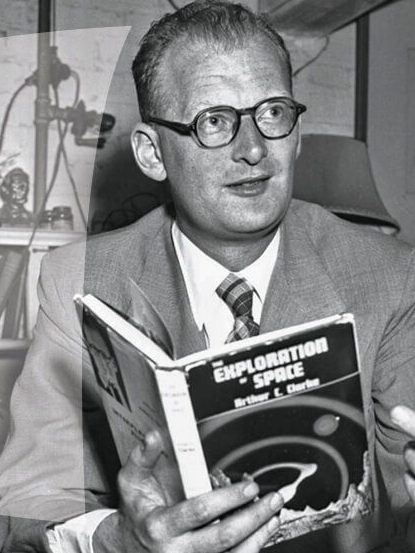
At the dawn of the space age, it hardly occurred to anyone that, just half a century later, society would feel quite the opposite about space exploration: “Why do we need space, anyway? There are already a lot of problems on Earth that urgently need solutions!” To understand the level of enthusiasm and scale of humanity’s hopes at the time, we suggest looking back at the predictions of the legendary futurist and writer <a href="https://en.wikipedia.org/wiki/Arthur_C._Clarke"><b><u>Arthur C. Clarke</u></b></a>, made in 1999: in 2014, no orbital hotels were opened; in 2015, we still hadn’t invented technology for transmuting chemical elements; in 2020, we haven’t yet managed to launch an automated probe to Proxima Centauri, the nearest star to the Sun; and in 2021, it is unlikely that we will land on Mars. Given the past failures, don't expect solar-powered interstellar aircraft by the 21st century's end.
Sir Arthur Charles Clarke (1917–2008) was a British writer, scientist, and futurist. Together with Stanley Kubrick, he worked on creating the script for the cult film 2001: A Space Odyssey. Arthur C. Clarke along with Isaac Asimov and Robert A. Heinlein are known as the “Big Three” of the science fiction genre of English-language literature.
Arthur Charles Clarke
"I am sometimes asked who I would like to remain in the memory of people: a writer, an explorer of the underwater world, a space expert, or a popularizer of science. Most of all, I would like to be remembered as a writer — one who not only entertained readers but also, I hope, expanded their imaginations."<br />
</blockquote>
In reality, over the past six decades of the space age, there have been no qualitative leaps forward in space flight technology. The modern field of astronautics cannot boast of anything so impressive in terms of innovation and significance as, for example, the breakthrough of jet propulsion in aviation in the 1960s. In fact, so far we’ve only managed to more or less master near-Earth space by using developments from half a century ago.</p><h3>Challenges of Long-Distance Space Travel</h3><p>Long-distance flights are even worse. The planets closest to us, Mars and Venus, are extremely inhospitable. The budget for just one human flight to Mars, according to experts, starts at $400 billion. It’s difficult to imagine how much it would cost to transform an entire planet. Most importantly, is it even possible in the case of Mars? It is unlikely that humanity would be willing to pay such a price for the development of the “red planet.” It might be a different story, however, if there were a planet that was already habitable…</p><br />
<figure>
<img width="699" height="919" src="https://oyla.us/wp-content/uploads/2023/06/image-02-e1688032116292.jpg" alt="Astronautics" /> <figcaption>Vostok 1. 1961</figcaption>
</figure>
<figure>
<img width="699" height="919" src="https://oyla.us/wp-content/uploads/2023/06/image-03-e1688032148863.jpg" alt="Space" /> <figcaption>Crew Dragon. 2020</figcaption>
</figure>
<h2>Look Further!</h2><br />
<p>Or maybe you recall the very same <b>Arthur C. Clarke’s Second Law</b>? “The only way of discovering the limits of the possible is to venture a little way past them into the impossible.” Maybe we should try to engage humanity in a more ambitious task and venture beyond our tiny home, minuscule on the scale of the universe. How about our Solar System?</p><br />
<h3>Clarke’s three laws</h3><br />
<ol><li>When a distinguished but elderly scientist states that something is possible, he is almost certainly right. When he states that something is impossible, he is very probably wrong.</li><li>The only way of discovering the limits of the possible is to venture a little way past them into the impossible</li><li>Any sufficiently advanced technology is indistinguishable from magic.</li></ol><br />
<p>In 1992, <a href="https://en.wikipedia.org/wiki/Aleksander_Wolszczan"><b><u>Aleksander Wolszczan</u></b></a> and <a href="https://en.wikipedia.org/wiki/Dale_Frail"><b><u>Dale Frail</u></b></a> were the first to discover planets outside of our Solar System (they are called exoplanets, from the Greek <i>exo</i>, meaning “outside”). Two planets were found near a radio pulsar — a wildly rotating neutron star that spits out enormous energy and bears little resemblance to our Sun. Any object near such a star is obviously uninhabited.
Scientists then posed the question: do star systems have planets similar to the Sun? We didn’t have to wait long for an answer. In December 1995, the star 51 Pegasi in the constellation Pegasus, 50 light-years away, drew the attention of Swiss astrophysicists Michel Mayor and Didier Queloz. An object impacted it, causing a change in its movement. The explanation was found: a massive planet, similar to Jupiter, orbits the star, only it is twice as light and has a surface about 1800°F hotter. Since then, a real hunt for exoplanets has commenced. To date, the existence of more than 4,000 planets outside of our Solar System has been confirmed.
Space | Exploring Earth-Like Exoplanets
The next step is to search for planets that are as similar to Earth as possible. Scientists are looking for them in the so-called “Goldilocks zone” or circumstellar habitable zone, the main feature of which is the possibility of finding water in the liquid phase. Astrophysicist Wesley Traub, after analyzing data from the Kepler mission (a telescope that specializes in searching for exoplanets and was in orbit from 2009 to 2013), came to an interesting conclusion: 20 %–40 % of “dwarf” stars similar to the Sun have exoplanets in the habitable zone! This means that the probability of the existence of a very close relative to the Earth is quite high, if not the existence of a “twin” of our planet itself.
Considering Extraterrestrial Life and Development
Whether there is life there and what level of development it has reached is another question. This makes it possible to give interstellar travel a practical dimension and start thinking about how to get there.
                                    Thus far, 4,183 exoplanets have been discovered by astronomers.Outside of our Solar System, 3,163 known stars have exoplanets, and 701 of them have entire planetary systems.Fifteen light-years from the Solar System lies one of the closest multi-planetary systems to us — the star Gliese 876 with 4 confirmed exoplanets.Today, 55 exoplanets are known to be potentially habitable.Twenty of them are the size of Earth, one is the size of Mars, and the remaining 34 are super-Earths.Kepler-452b is called "Earth 2.0" because of its supposed similarity to our planet. This object is located 1,400 light-years away from us.
                        <svg aria-hidden="true" viewBox="0 0 1000 1000" xmlns="http://www.w3.org/2000/svg"><path d="M646 125C629 125 613 133 604 142L308 442C296 454 292 471 292 487 292 504 296 521 308 533L604 854C617 867 629 875 646 875 663 875 679 871 692 858 704 846 713 829 713 812 713 796 708 779 692 767L438 487 692 225C700 217 708 204 708 187 708 171 704 154 692 142 675 129 663 125 646 125Z"></path></svg>                            Previous slide
                        <svg aria-hidden="true" viewBox="0 0 1000 1000" xmlns="http://www.w3.org/2000/svg"><path d="M696 533C708 521 713 504 713 487 713 471 708 454 696 446L400 146C388 133 375 125 354 125 338 125 325 129 313 142 300 154 292 171 292 187 292 204 296 221 308 233L563 492 304 771C292 783 288 800 288 817 288 833 296 850 308 863 321 871 338 875 354 875 371 875 388 867 400 854L696 533Z"></path></svg>                            Next slide
        <h2>Closed for Inventory</h2>
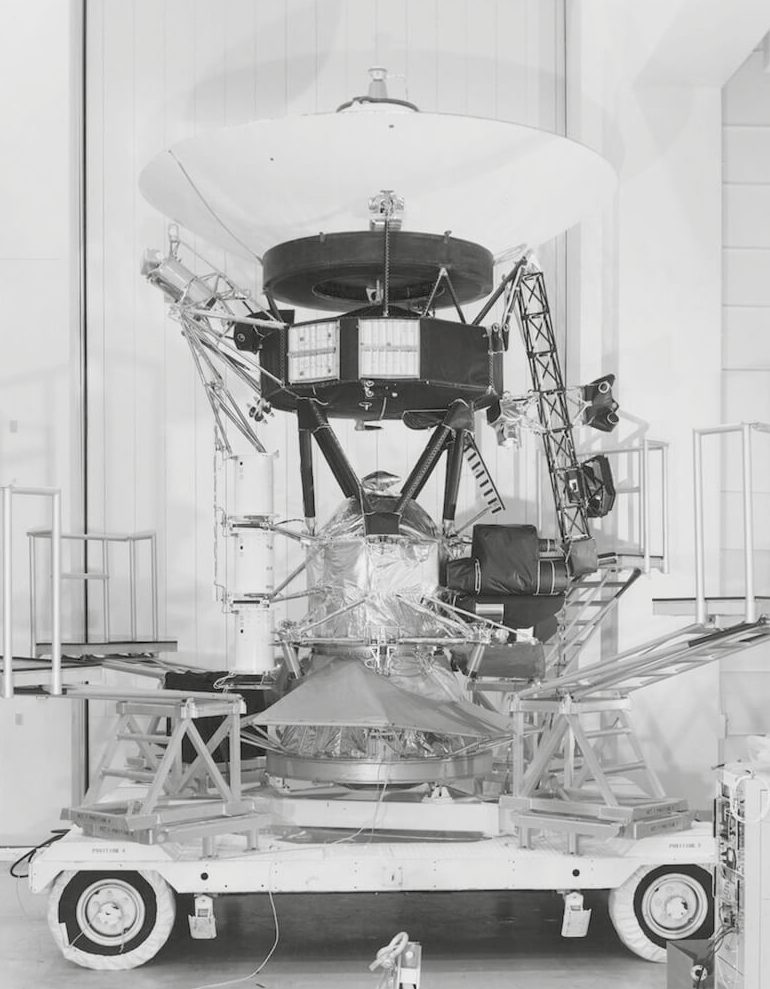
    <p>Modern chemical engines have allowed humankind to overcome the atmosphere's transparent “armor.” For example, <em>Voyager 1</em> moved over 13.5 billion miles from Earth, about 150 times the distance to the Sun, in nearly 43 years. This is impressive but microscopic on a universal scale. Its top speed of 38,000 mph (relative to the Sun) was achieved mainly through clever gravitational maneuvers rather than its engine.
Similarly, the fastest spacecraft, the Parker Solar Probe, reached 213,200 mph on November 5, 2018, surpassing the 1976 record of 156,500 mph set by Helios 2. By 2025, Parker is expected to achieve a speed of 430,000 mph relative to the Sun.
Voyager-1. 1977Parker Solar Probe. 2018
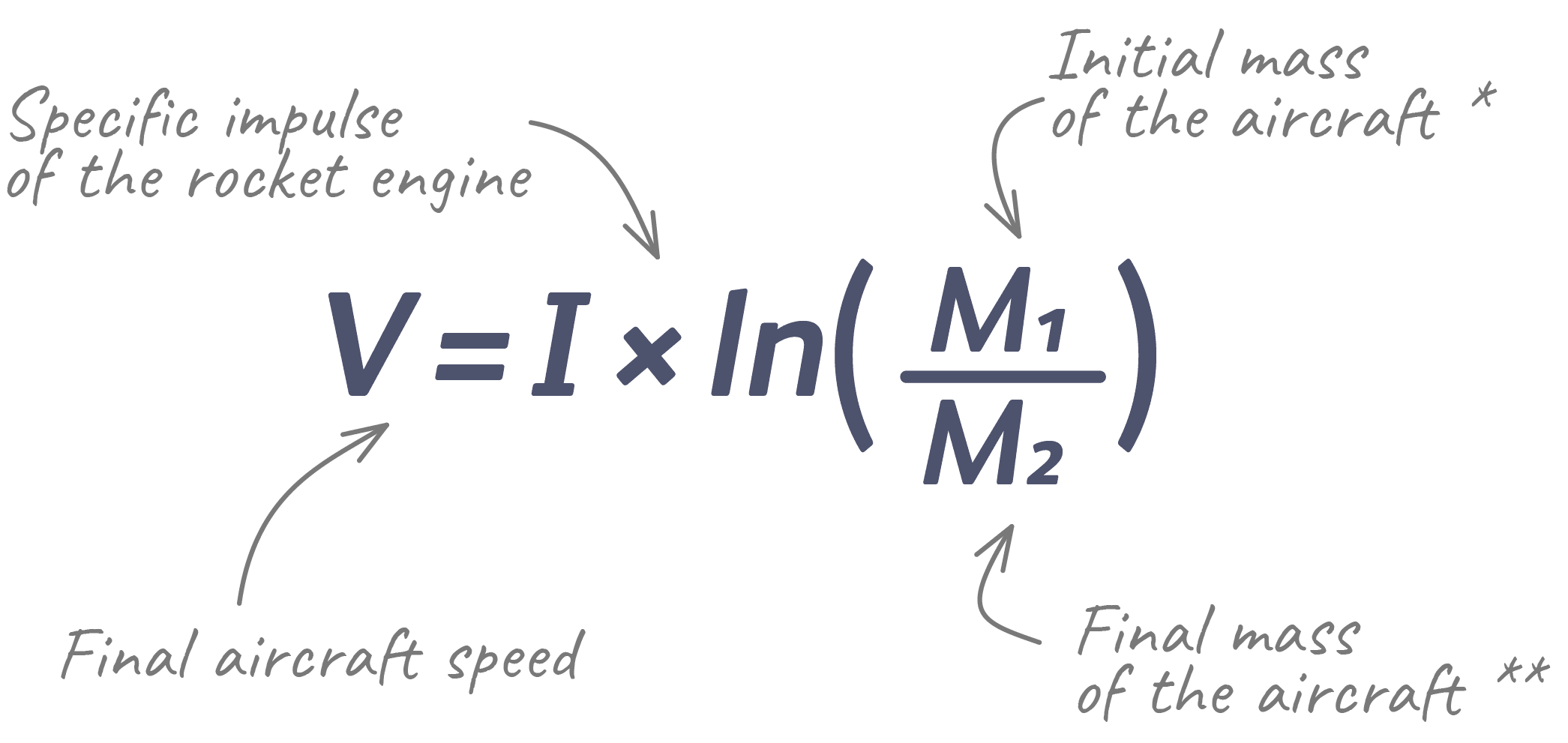
Such speeds are made possible by the powerful attraction of the Sun and the giant planets used for gravitational maneuvers. But isn’t it possible to achieve such speeds on our own? Unfortunately, no: modern chemical engines based on the exothermic reaction of fuel and an oxidizer compound cannot achieve this in principle. There is an insurmountable obstacle — the Tsiolkovsky rocket equation:
* Payload + vehicle structure + fuel
** Payload + vehicle structure
The Challenges of Increasing Rocket Speed
According to this formula, the speed of a rocket can be increased in two ways. The first is to take as much fuel as possible, even at the expense of the payload. What happens in practice? For example, if the mass of a spacecraft is assumed to be 16.5 t, then to accelerate it to the speed of “Parker” (≈213,000 mph), you would have to take all the oil reserves on the Earth (≈220 billion t) with you!
In other words, there is no real engineering capability that can achieve such high speeds with single-stage rockets. In addition, the Tsiolkovsky equation does not take into account the need to overcome the Earth’s gravitational pull — it is at this stage that modern rockets spend the majority of their fuel. Spacecraft are launched by multistage carriers, which on average account for 90 % of the total mass. Do not forget that the remaining 10 % includes not only the payload (satellite, manned ship, etc.), but also the structure of the craft itself — the hull, engines, tanks, pipes, and hundreds of thousands of parts without which it cannot work. So, the astronauts have to endure severe weight limitations and take into account literally every gram to meet the carefully-calculated percentages of the payload.
                                                <img width="442" height="681" src="https://oyla.us/wp-content/uploads/2023/06/image-09-e1688033666100.jpg" alt="The example of the Space Shuttle ships demonstrates that up to 95 % of the total mass is occupied by fuel installations. The rocket plane itself and its payload make up only 5 % of the total launch mass" />
                                    <figure>
                                    <img width="800" height="668" src="https://oyla.us/wp-content/uploads/2023/06/scheme-03-5.png" alt="The example of the Space Shuttle ships demonstrates that up to 95 % of the total mass is occupied by fuel installations. The rocket plane itself and its payload make up only 5 % of the total launch mass." />                                         <figcaption>The example of the Space Shuttle ships demonstrates that up to 95 % of the total mass is occupied by fuel installations. The rocket plane itself and its payload make up only 5 % of the total launch mass</figcaption>
                                    </figure>
    <h3>Exploring Alternative Fuels</h3><p>But there is another variable in the Tsiolkovsky equation, the <b>specific impulse</b>, which can be considered with sufficient accuracy to be equal to the rate of expiration of the combustion products! Maybe we should just find better fuel? But even here, humanity has reached its limit. Currently, a “hydrogen-oxygen” pair is used, providing a speed of 10,000 mph. The most common combination of “kerosene-oxygen” is much slower — only 7,000 mph, and the “methane-oxygen” combination, promising in terms of efficiency and energy intensity of the steam, can only offer up 7,800 mph.
The main conclusion that follows from the Tsiolkovsky formula is that chemical rockets are unsuitable for serious travel in space. The fact that we continue to use them can be considered pure luck: if the mass of the Earth was just 40% greater, then chemical rocket engines could under no circumstances take us to near-Earth orbit, let alone on long-distance travel.
Predictions from Arthur C. Clarke. The 21st century.
The first consumer device for energy production, absolutely clean and safe, based on principles of low-temperature nuclear reactions, will be released to the market. This means the end of the era of fuel extracted from minerals.
OYLA: There is no such device at the moment. It is still unclear how much time is left until the end of the fossil fuel era. Currently, 85 % of energy is generated from mineral extraction.
2003
Internal combustion engines (ICE) in cars will be replaced with new devices for generating energy.
OYLA: Internal combustion engines are still used in 90 % of the world’s cars. Interestingly, the company Tesla, which produces electric cars, was founded in 2003.
OYLA: There are about 14,000 nuclear weapons in the world.
2010
Generators powered by space energy will be developed. Power plants will begin to close; their time is up. Electrical networks will be dismantled.
OYLA: There are no such generators. We still generate power from power plants.
2014
Construction of the Hilton Orbital Hotel will begin. Giant cargo bays of “shuttles” that previously fell to Earth and burned up in the atmosphere will be used as building materials.
OYLA: So far, the only place in space where a person can live is the International Space Station. But in 2021, the launch of the Aurora Station is planned — the first space hotel, which will begin to receive guests in 2022.
2015
Technology for the transmutation of chemical elements will be developed, allowing us to control the structure of materials. Lead and copper, due to their greater utility than gold, will become twice as expensive as the “noblest metal.”
OYLA: There is no such technology yet. Gold is still more expensive than copper and lead.
2016
Megawatt-hours will become the international unit of currency.
OYLA: There are about 180 different currencies in the world.
2019
A huge meteorite will fall on the cap of the North Pole. Serious damage will be caused to the coast of Greenland and Canada. The “Spaceguard” project will be launched to identify and divert potentially dangerous comets and asteroids from Earth.
OYLA: In 2013, a meteorite fell near the city of Chelyabinsk (Russia). The damage was not catastrophic. There are various projects to detect space objects that are dangerous to the Earth, such as Pan-STARRS, ATLAS, NEAT, and others.
2020
Artificial intelligence (AI) will reach the level of human intelligence. On Earth, two types of intelligence will coexist: biological and non-biological. Humanity will send spaceships with artificial intelligence to the nearest stars.
OYLA: It is too early to talk about the coexistence of two types of minds, although artificial intelligence is already used in scientific research, and it helps in the production of satellites, spacecraft, and processing photos from space.
Came true
Satellite communication systemsIn 1945, Clarke popularized the idea of creating global communication systems in the Wireless World magazine. He described a system of communication satellites in geostationary orbit, which today are sometimes called “Clarke orbits” in honor of the science fiction writer.The lunar landingIn the 1947 science fiction novel, Prelude to Space, Clarke suggested that in 31 years, a spacecraft capable of reaching the Moon would be created. “When the book was published in 1951, I thought I was being fiendishly optimistic when I predicted the lunar landing in 1978,” Clarke said. As you know, Neil Armstrong and Edwin “Buzz” Aldrin landed on the surface of the Moon for the first time in history in 1969. Clarke himself conducted live television coverage of the expedition.
The invention of the InternetClarke’s thoughts on the prospects of communication in 1964 were as follows: “We could be in instant contact with each other, wherever we may be, where we can contact our friends anywhere on Earth, even if we don’t know their actual physical location…It will be possible in that age, perhaps only 50 years from now, for a man to conduct his business from Tahiti or Bali just as well as he could from London.”
Predicting the weatherIn 1954, Clarke suggested that weather could be predicted using orbiting satellites. The scientific community supported his idea and subsequently, in addition to data from ground-based weather stations, began to turn to artificial Earth satellites for information.
Remote surgical operations”I am perfectly serious when I suggest that one day we may have brain surgeons in Edinburgh operating on patients in New Zealand,” Clarke fantasized in 1964. So it happened. Robotic surgery in the United States began to be practiced in 2000. The da Vinci Surgical System is one such example.
Previous slide
Next slide
Space | Strong but Slow, Fast but Impossible
Now we’re in an interesting situation: we have engines with a huge thrust that can break the shackles of Earth’s gravity, but because of their small specific momentum, we are “locked” in our planetary system. Where is the answer? We will not consider the space warpers, compressors, and staplers that turn the universe into origami — we’d rather leave such fantasy to science fiction writers. Let’s consider the problem of “getting from point A to point B, the distance between which is several light-years,” based on the modern technical capabilities of rocket science. The only way out of the chemical “dead end” will be fundamentally different engines with a much larger specific impulse, ideally close to the speed of light.
Looking ahead, we note that there are many projects working to construct such supermachines. There are also thermonuclear engines, theoretically capable of providing a specific impulse of up to 67,000,000 mph. Its variation is the “interstellar ramjet engine,” designed by physicist Robert Bussard, who proposed the collection of hydrogen and dust directly in space. Or we have the exploding rockets of the Polish mathematician Stanislaw Ulam, or photon annihilator ships that have already become a standard in science fiction. Also worth mentioning are the exotic solar and laser sails that symbolically take us back to the era of great geographical discoveries, and the amazing EmDrive by Roger Scheuer, nicknamed the “flying bucket.”
“Impossible” engine
The EmDrive engine, according to its inventor, Roger Scheuer, allows you to convert radiation into thrust, which can help us reach the edge of the Solar System in a few months, not decades.
However, not all engineers consider such an engine to be functional, since it violates one of the fundamental laws of physics, the law of conservation of momentum.
Unfortunately, none of these projects will be implemented in the near future. There are still fundamental, unresolved problems, the first of which is huge energy consumption. It is still unclear how to produce so much energy. It is not yet even approximately clear how to carry out, for example, thermonuclear fusion or create antimatter on an industrial scale. But if work is still being done in these areas, there is not even a rough outline of a solution for the second problem. The fact is that it is not clear how to resist the huge strain of space.
The Strain of Interstellar Space Travel
Consider the strain of space travel. Space isn’t a vacuum, it’s an extremely sparse gas with one proton per cubic centimeter, akin to 3/50 of a cubic inch.). Moving at sub-light speeds through this gas, a ship will experience a proton flux. Soviet cosmonaut and scientistKonstantin Feoktistov estimated its power at 100 kW/m2 (about 12.5 hp/ft2) which is almost 100 times stronger than solar radiation — and this is only under the influence of hydrogen! Now picture a speck of dust, weighing just a few ounces, hurtling towards a ship at 335 million miles per hour! Its kinetic energy equals that of a 2.5 ton TNT explosion. And what if it were a small rock? These are just a couple of the myriad problems. Without solving these, there’s no point in tackling the rest.
Space | WHAT’S AHEAD?
2023
Dinosaurs are cloned from fragments of DNA. In Florida, Disney opens a theme park with dinosaurs. Mini-raptors are beginning to replace guard dogs.
2024
Infrared spectrum signals are received from the center of the Milky Way galaxy. They clearly come from a technologically advanced civilization, but all attempts to decipher them are in vain.
2025
Neurological research leads to an understanding of the nature of feelings. Full immersion in virtual reality becomes possible.
2040
Thanks to the “universal replicator,” you can recreate any object, from fine dishes to diamonds. Agriculture and heavy industry become obsolete, and the need for hard physical labor disappears. Art, education and entertainment flourish.
2045
Fully autonomous, self-sustainable mobile homes appear. For food synthesis, carbon is extracted from carbon dioxide.
2050
Tired of living in an era that is too dull, millions of people decide to enter cryogenic sleep in order to “immigrate” to the future.
2051
Autonomous robotic colonies appear on the Moon.
2057
On October 4, 100 years will have passed since the first satellite was launched. The anniversary is celebrated not only on Earth but also on the Moon, Mars, Europa, Ganymede, and Titan.
2061
Halley’s comet returns and humans land on its surface for the first time. Both dormant and active life forms are detected on the comet.
2090
An expected ice age does not occur due to global warming (the burning of fuel to replenish carbon dioxide reserves has resumed).
2095
A “space drive” is invented that allows for reaching speeds close to the speed of light. Researchers are sent to neighboring star systems.
2100
The future is just beginning…
It may seem that we are at an impasse, but the history of humankind is full of examples in which a solution was found to an impossible situation. All that’s left is to set such a goal for ourselves.
Did you like the post? We invite you to read our other topics in Education category.